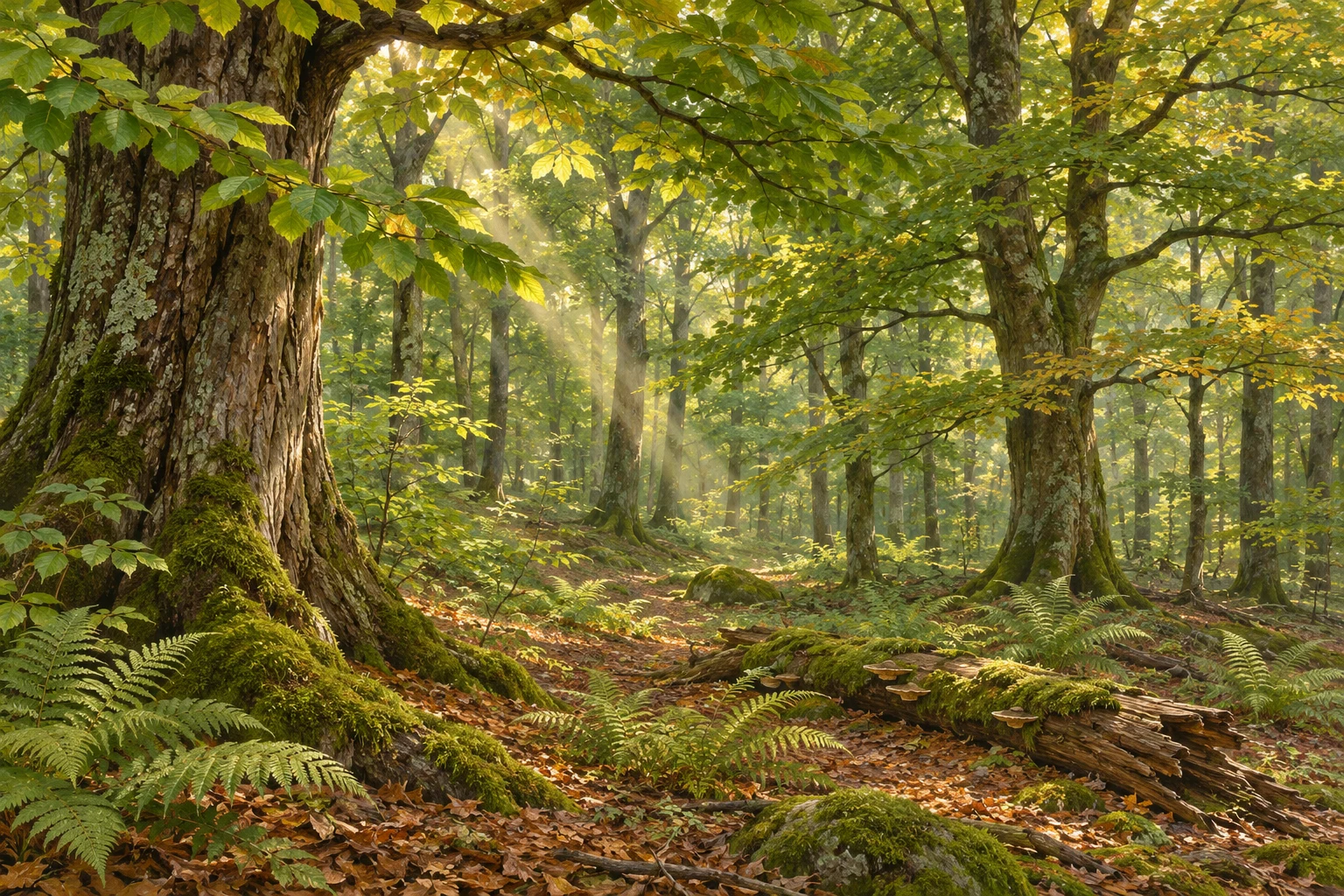
Ecological context
A system, not a backdrop
A guide to the landscape, its changes and ways to care for it. This profile covers a broad habitat type; local data need site-specific research.
Habitat guide
How it works
Environmental conditions
Light and moisture vary between gaps, understorey and canopy; local climate modifies this pattern.
Distribution and scope
This is a temperate-forest overview, not an inventory of every forest in Spain.
Structure
Soil, trunks, understorey and canopy form distinct layers and microhabitats.
Ecological processes
Leaf fall, decomposition and regeneration connect trees, fungi and animals.
Habitat guide
Change and care
Seasonal changes
Leaf emergence, flowering and leaf fall change the light reaching the understorey. Soil moisture and fruit supply vary through the year; timing depends on region and dominant trees.
Threats
Structural simplification, removal of deadwood, fragmentation and invasive species can reduce microhabitats. Actual pressure depends on climate and local management.
Conservation
Retaining trees of different ages, understorey and safe amounts of deadwood supports shelter and food. Management must be tailored to each forest.
Responsible observation
Compare a gap, a shaded patch and a fallen log. Record season and moisture without collecting fungi or disturbing leaf litter.
Linked species are documented examples for a specific area. The list is not complete, and the absence of a species does not prove that it is not present.
Sources and references View references Hide references 3
Evidence base
References for checking the processes and pressures described. Regional sources do not make this overview a local inventory.
- IUCN Global Ecosystem Typology IUCN Red List of Ecosystems
- Forest biodiversity European Environment Agency
- How can we enhance forest biodiversity? European Environment Agency