Ecological context
A system, not a backdrop
A guide to the landscape, its changes and ways to care for it. This profile covers a broad habitat type; local data need site-specific research.
Habitat guide
How it works
Environmental conditions
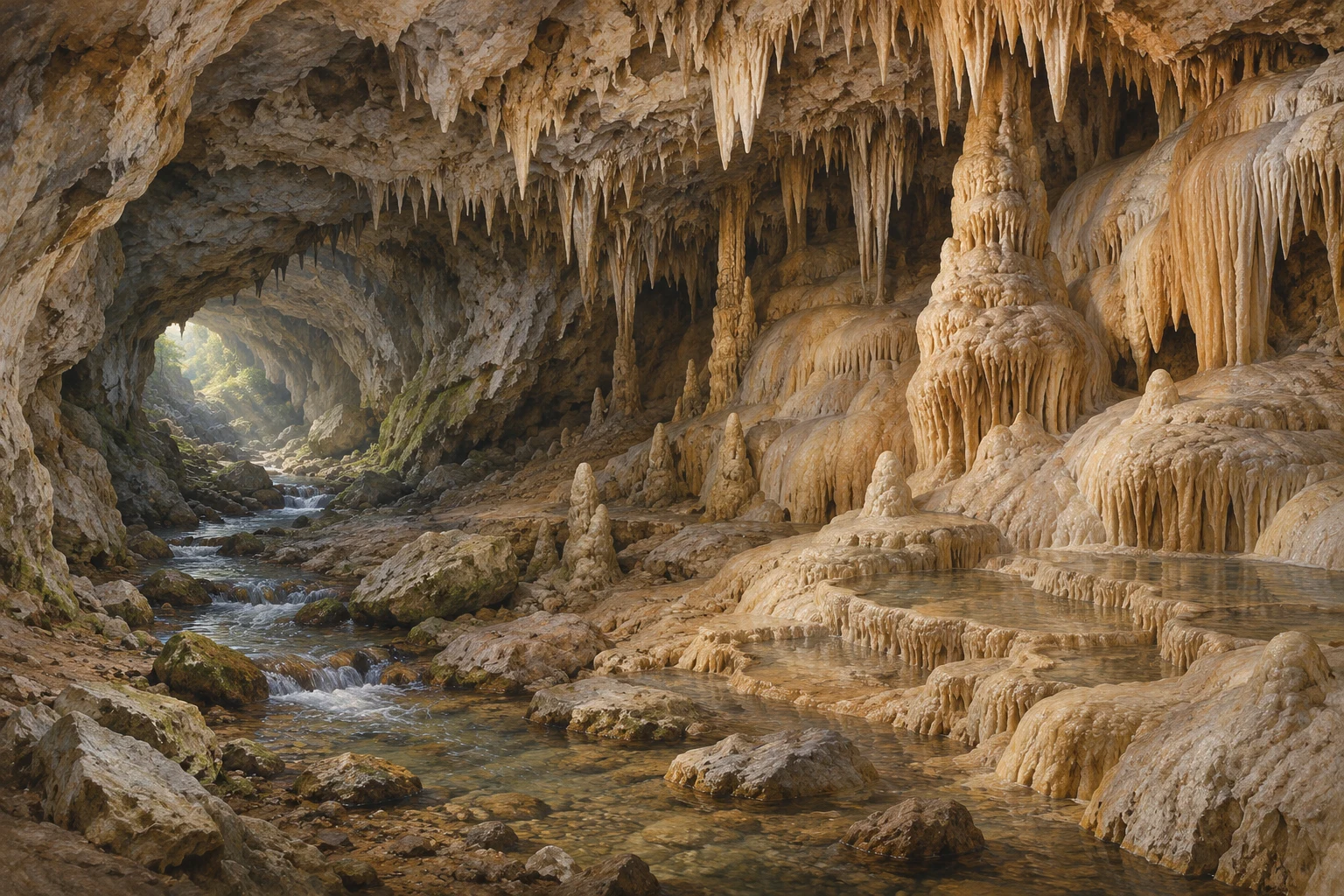
In Spain, these cavities are generally associated with Jurassic and Cretaceous carbonate massifs or Upper Miocene and Pliocene carbonate platforms, although they also occur occasionally in other lithologies.
Distribution and scope
In peninsular Spain, the technical source highlights the joint presence of continental and coastal cavities in Cantabria, Asturias, Castile and León, Andalusia, Castile-La Mancha, and the Valencian Community; it does not give a separate distribution for continental cavities.
Structure
Karst cavities are classified as horizontal or vertical developments, inland or coastal caves, and epigenic, hypogenic, or mixed cavities according to the hydrogeological relationship of their waters.
Ecological processes
Rock dissolution, often guided by faults, fractures, or differences in solubility, forms karst cavities; in addition, the Alpine long-nosed bat has been recorded hibernating in icy caves in the Pyrenees at elevations above 2,100 m.
Linked species are documented examples for a specific area. The list is not complete, and the absence of a species does not prove that it is not present.
Sources and references View references Hide references 2
Evidence base
References for checking the processes and pressures described. Regional sources do not make this overview a local inventory.
- Establecimiento de una tipología de unidades geológicas y ... www.miteco.gob.es
- Plecotus macrobullaris Kuzyakin, 1965 www.miteco.gob.es