Ecological context
A system, not a backdrop
A guide to the landscape, its changes and ways to care for it. This profile covers a broad habitat type; local data need site-specific research.
Habitat guide
How it works
Environmental conditions
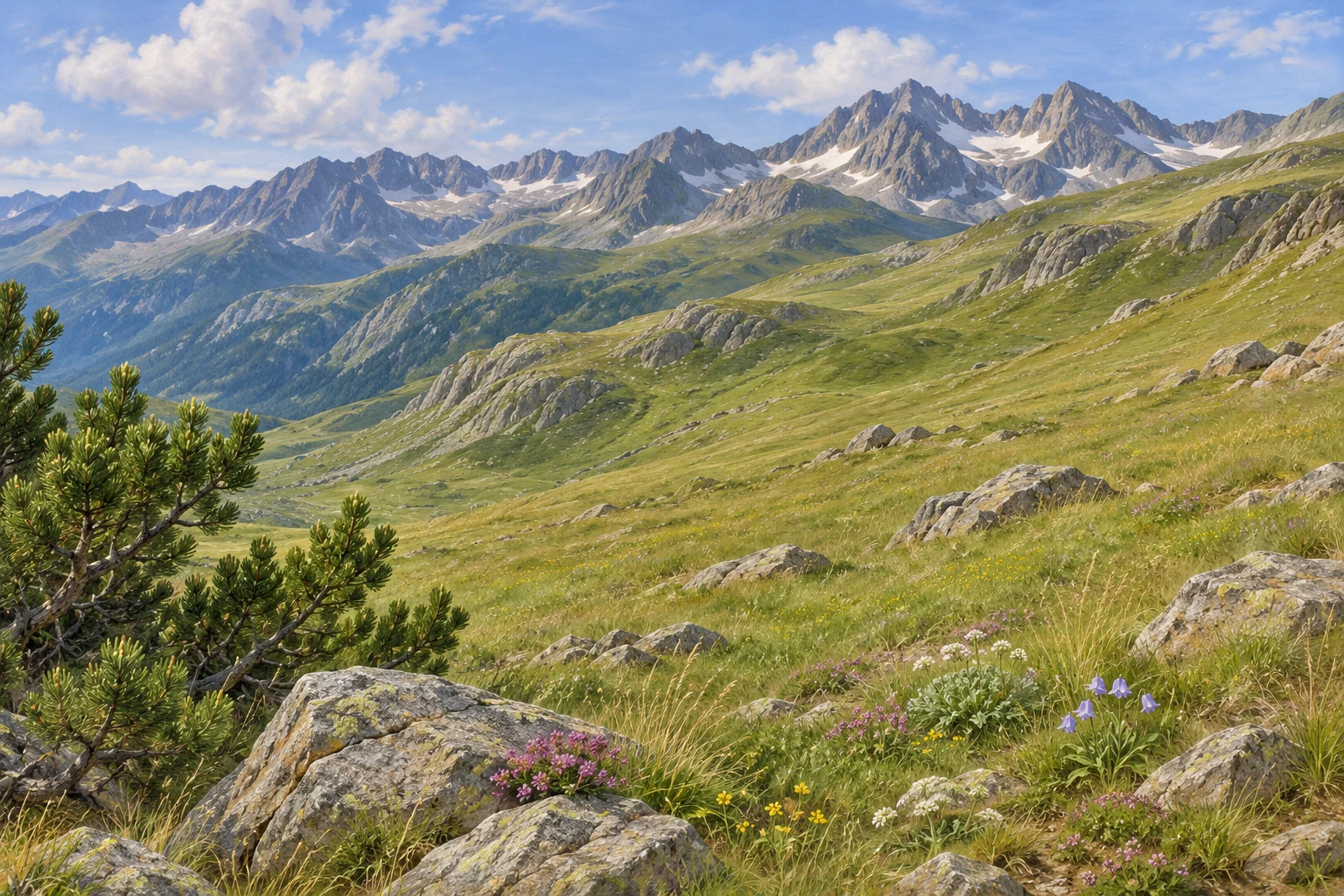
The park’s source states that above 2,200 m, climatic conditions are so harsh that few trees can grow. It describes grasslands according to altitude, aspect and substrate; Festuca eskia dominates extensive high-mountain grasslands on acidic substrates.
Distribution and scope
This profile is limited to Aigüestortes i Estany de Sant Maurici National Park, in the Pyrenees. The source describes sunny-slope grasslands, subalpine areas and the park’s few calcareous areas.
Structure
Sunny-slope grasslands are dominated by Festuca paniculata, accompanied by various herbs and flowers. In subalpine areas where forests have been cleared, Nardus stricta grasslands occur, with Festuca nigrescens or Festuca eskia, among other plants. On acidic substrates, Festuca eskia dominates extensive grasslands and may grow alongside Trifolium alpinum, Nardus stricta, Campanula scheuchzeri, Gentiana alpina and Ranunculus pyreaneus. In the few calcareous areas, stony, dry slopes may be dominated by Festuca gautieri; on less steep, dry ground, denser grasslands, mainly of Festuca nigrescens, are described.
Ecological processes
In subalpine areas where forests have been cleared, Nardus grasslands occur. The source describes this relationship in the park without presenting it as an explanation for all Pyrenean Nardus grasslands.
Habitat guide
Change and care
Seasonal changes
According to the park’s description, extensive high-mountain meadows are awash with colour in summer as numerous plants flower.
Linked species are documented examples for a specific area. The list is not complete, and the absence of a species does not prove that it is not present.
Sources and references View references Hide references 1
Evidence base
References for checking the processes and pressures described. Regional sources do not make this overview a local inventory.
- Aigüestortes i Estany de Sant Maurici: La alta montaña www.miteco.gob.es