Ecological context
A system, not a backdrop
A guide to the landscape, its changes and ways to care for it. This profile covers a broad habitat type; local data need site-specific research.
Habitat guide
How it works
Environmental conditions
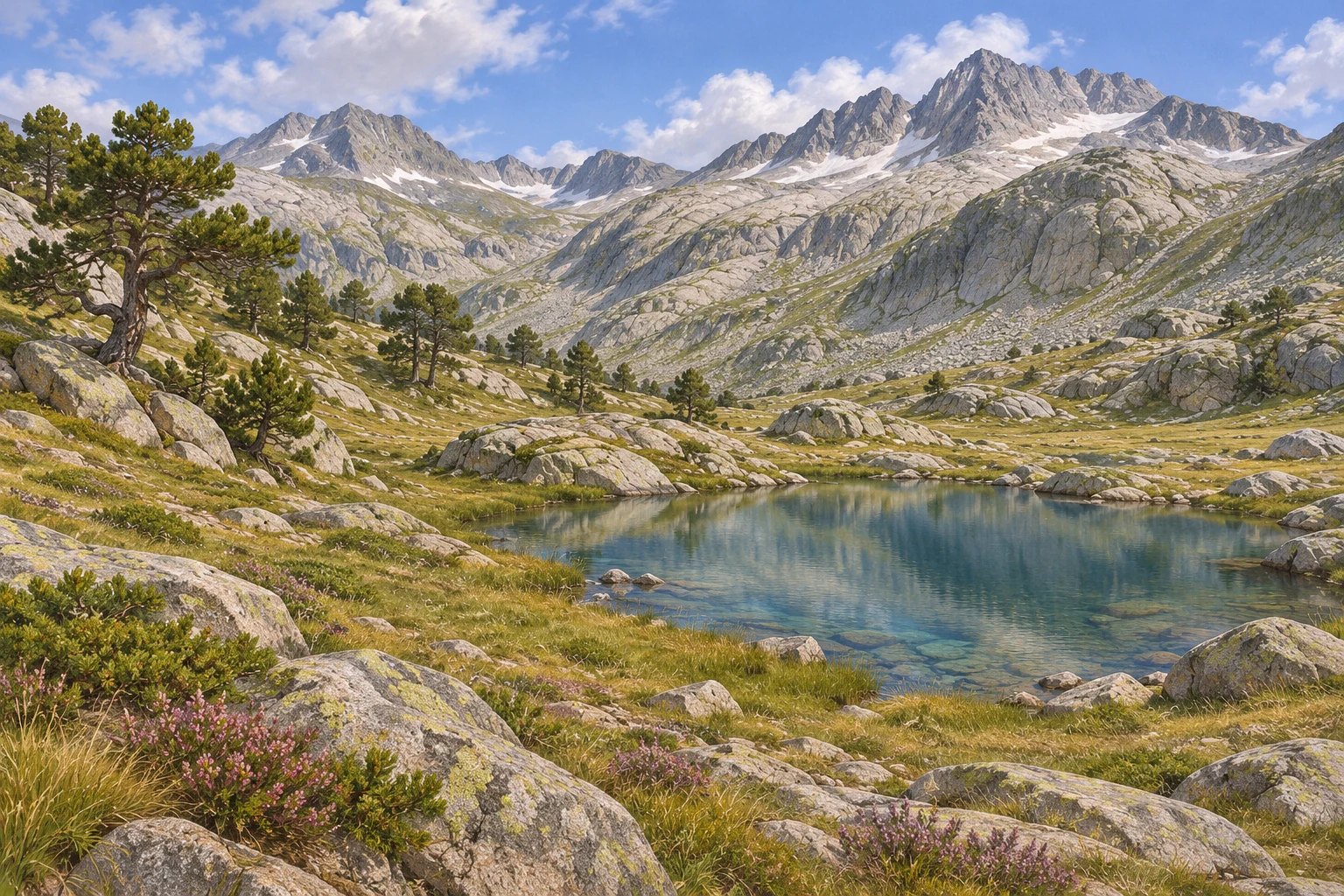
Above 2,200 m, climatic conditions are so harsh that few trees can grow. The composition of the grasslands varies according to altitude, aspect, and the substrate on which they grow.
Distribution and scope
This profile is confined to the high mountain zones of the Aigüestortes i Estany de Sant Maurici National Park, where the source locates these conditions starting from 2,200 m.
Structure
The landscape comprises extensive scree slopes, home to numerous birds, and meadows that in summer are covered in color due to the flora. In areas where trees cannot grow, such as rocky slopes, boulders, and avalanche corridors, high mountain shrublands are found. In shaded aspects, rhododendron dominates, accompanied by blueberries, alpine rose, Gentiana burseri, and Homogyne alpina; on sunny slopes, a shrubland of boxwood and junipers. The grasslands include types dominated by Festuca paniculata on sunny slopes, Nardus stricta grasslands in subalpine zones, calcareous grasslands rich in species such as Festuca gautieri, and extensive Festuca eskia grasslands on acidic substrates.
Linked species are documented examples for a specific area. The list is not complete, and the absence of a species does not prove that it is not present.
Sources and references View references Hide references 1
Evidence base
References for checking the processes and pressures described. Regional sources do not make this overview a local inventory.
- Aigüestortes i Estany de Sant Maurici: La alta montaña www.miteco.gob.es