Ecological context
A system, not a backdrop
A guide to the landscape, its changes and ways to care for it. This profile covers a broad habitat type; local data need site-specific research.
Habitat guide
How it works
Environmental conditions
The holm oak forest is characteristic of the Mediterranean realm, where dry summers and autumn to spring rainfall are common. However, the conditions of Iberian sites are not uniform: the holm oak also appears in wetter or transitional places, and the regions of origin span different climatic contexts.
Distribution and scope
The holm oak is found in extensive areas of the Iberian Peninsula. The documentation of its regions of origin describes a gradient, from wetter northern regions to drier southern ones, but this characterization does not by itself establish local boundaries or a current surface area of the holm oak forest.
Structure
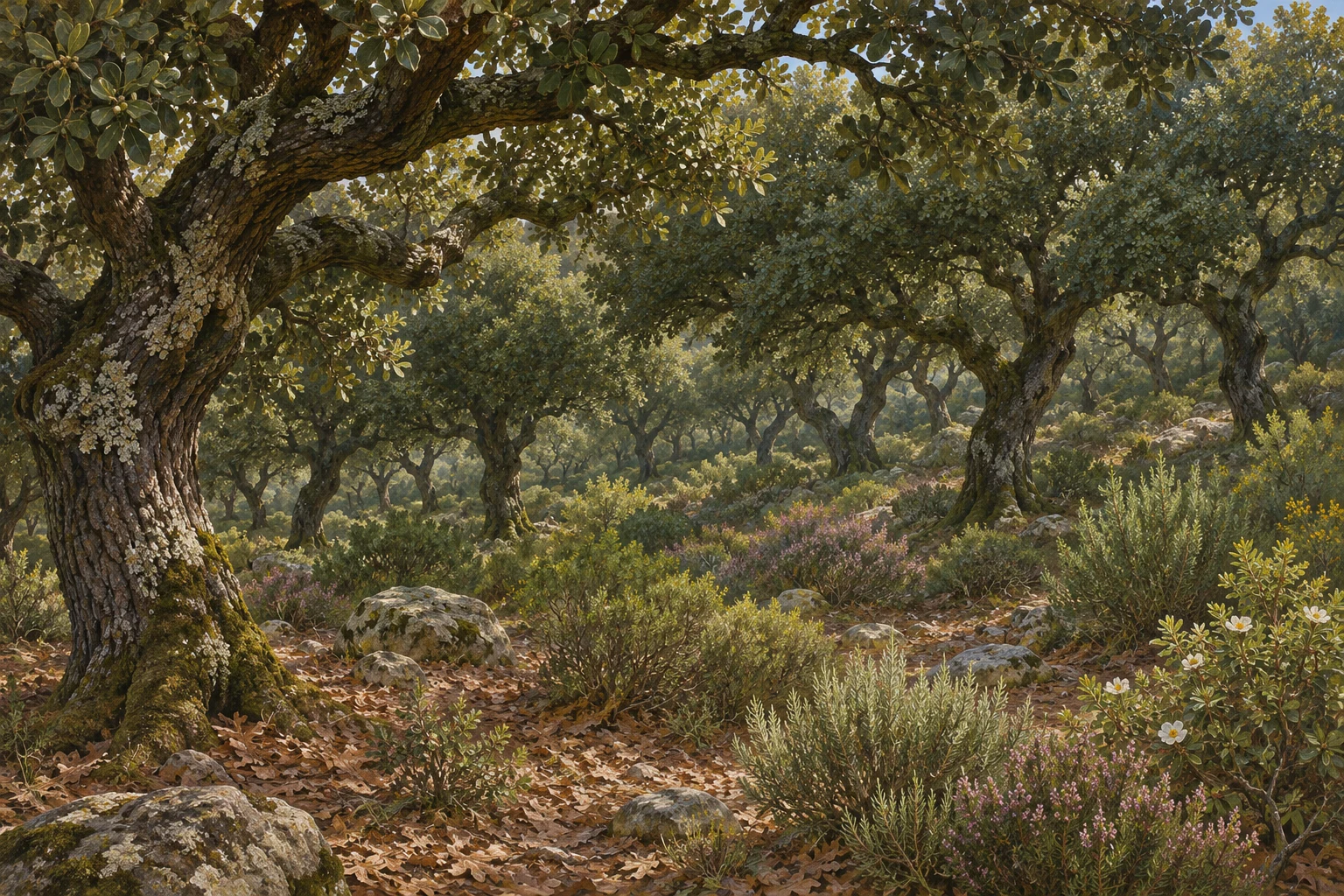
Holm oak forests are evergreen formations: leaves are renewed individually, so the crown retains foliage throughout the year. They can form a continuous and shady tree layer, with a dense and diverse shrub understory and a poorly developed herbaceous layer.
Ecological processes
Mediterranean scrubland can be natural or appear as a replacement stage of forest formations, including holm oak forests, after fires, plowing, abandoned crops or pastures, and other uses. The source presents several possible processes, not an inevitable or identical trajectory in all places.
Linked species are documented examples for a specific area. The list is not complete, and the absence of a species does not prove that it is not present.
Sources and references View references Hide references 5
Evidence base
References for checking the processes and pressures described. Regional sources do not make this overview a local inventory.
- Encinar es.wikipedia.org
- DIVERSIDAD, PALEOFITOGEOGRAFÍA Y ELEMENTOS FLORÍSTICOS L www.miteco.gob.es
- Encina (Quercus ilex) - Parque Nacional Picos de Europa www.miteco.gob.es