Ecological context
A system, not a backdrop
A guide to the landscape, its changes and ways to care for it. This profile covers a broad habitat type; local data need site-specific research.
Habitat guide
How it works
Environmental conditions
The mountain climate has fluctuations and changes linked to the winds; in winter, snow covers extensive areas, and when spring arrives, its melt feeds torrents that flow toward the valleys.
Distribution and scope
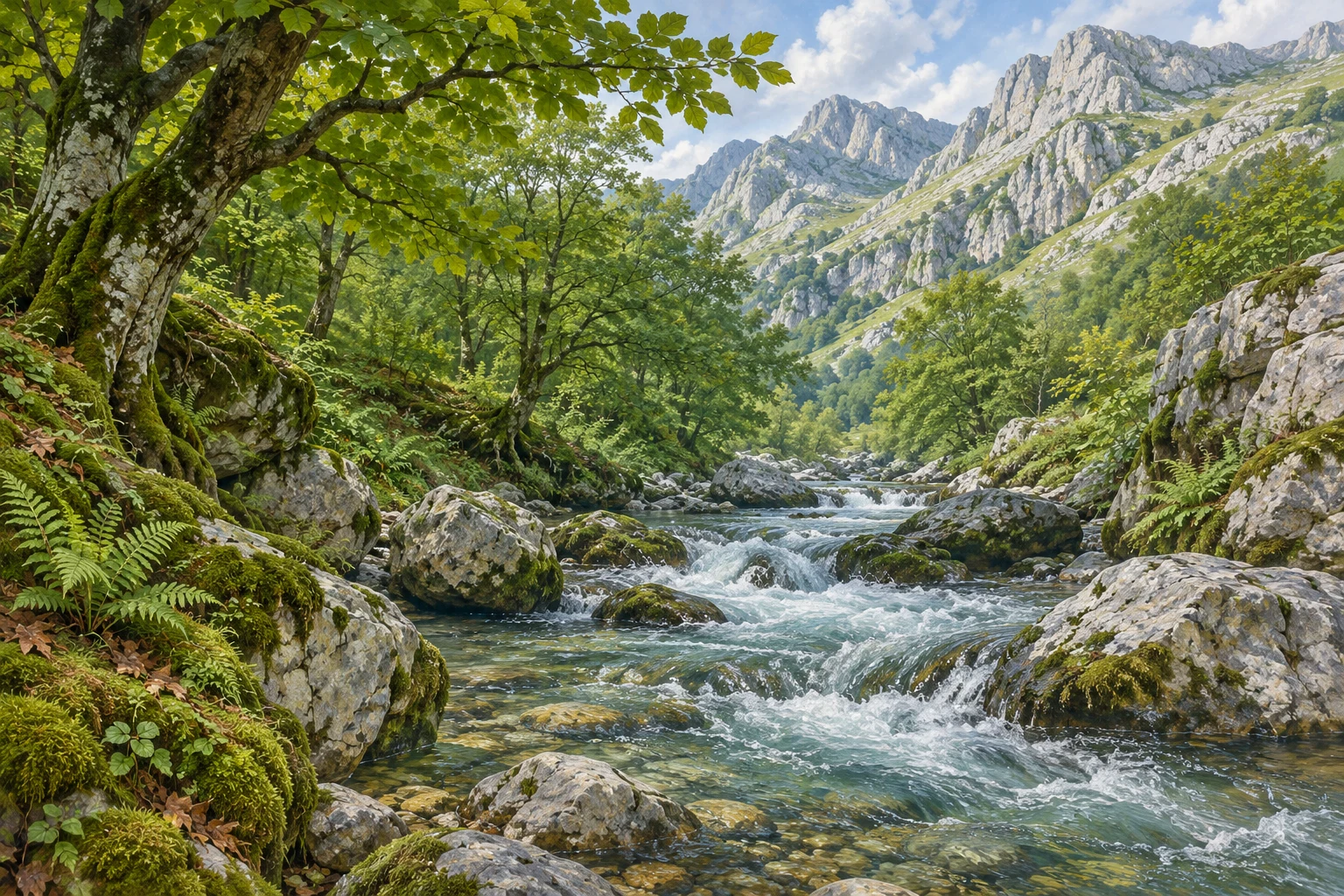
This profile is limited to the mountain courses of Picos de Europa National Park, in the north of the Iberian Peninsula, in the Cantabrian Mountains, between Asturias, Cantabria and Castile and León; the rivers described include the Sella, Cares, Deva and Duje.
Structure
The rugged terrain combines high peaks with deep gorges and canyons, through which rivers descend from the mountain range toward the valleys; the park also includes streams and mountain lakes.
Ecological processes
Spring snowmelt gives way to the flow of torrents; in Picos de Europa, a research project examines how hydrological variability relates to the physical characteristics of river habitat and to biological communities.
Habitat guide
Change and care
Seasonal changes
Snow covers much of the area during winter, and its spring melt gives way to flowing torrents, a seasonal variation described for the Picos de Europa surroundings.
Conservation
In Picos de Europa, it was proposed that monitoring of the conservation status of river ecosystems be optimized, taking account of variability in biological communities and their relationship to hydrology and habitat characteristics.
Linked species are documented examples for a specific area. The list is not complete, and the absence of a species does not prove that it is not present.
Sources and references View references Hide references 19
Evidence base
References for checking the processes and pressures described. Regional sources do not make this overview a local inventory.
- Península ibérica es.wikipedia.org
- Fauna de la península ibérica es.wikipedia.org
- Geology of the Iberian Peninsula en.wikipedia.org
- List of least concern fishes en.wikipedia.org
- Chili fr.wikipedia.org
- Royaume des Asturies fr.wikipedia.org
- Berrocal fr.wikipedia.org
- Notre-Dame du Rocher de France fr.wikipedia.org
- Panthera onca it.wikipedia.org
- Gliedkräuter de.wikipedia.org
- Castela e Leão pt.wikipedia.org
- Florestas da Península Ibérica pt.wikipedia.org
- Serra de Gredos pt.wikipedia.org
- Optimización de las redes de seguimiento del estado de ... www.miteco.gob.es
- Ecosistemas acuáticos de alta montaña: refugio de ... www.miteco.gob.es
- Reserva Natural Fluvial del río Viejas www.miteco.gob.es
- Reserva Natural Fluvial Río Montoro www.miteco.gob.es
- Picos de Europa: El medio natural www.miteco.gob.es
- Cantabria en.wikipedia.org