Ecological context
A system, not a backdrop
A guide to the landscape, its changes and ways to care for it. This profile covers a broad habitat type; local data need site-specific research.
Habitat guide
How it works
Environmental conditions
At White Sands, groundwater lies close to the surface and helps keep the dune field moist. National Park Service information indicates 99% humidity year-round; this figure is part of the park’s description and does not mean that all the sand is saturated.
Distribution and scope
The dune field is in the Tularosa Basin, New Mexico. Lake Lucero and Alkali Flat, in the southwestern part of the basin, are major sources of new sand for the park’s dunes.
Structure
The dunes are made of gypsum sand. Their grains come from selenite crystals that break into particles transportable by wind.
Ecological processes
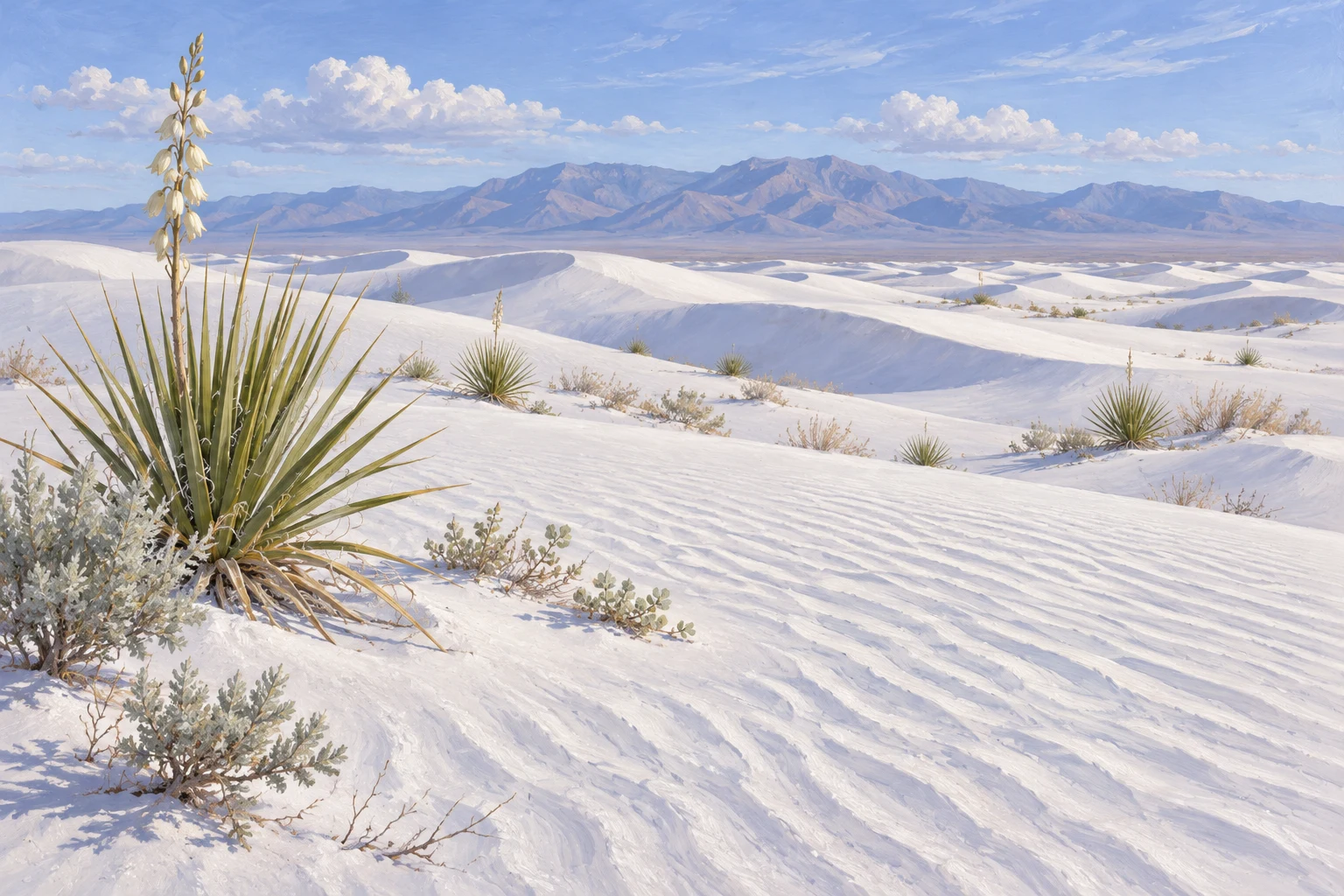
Gypsum entered the basin with runoff during a wetter period and was deposited in ancient Lake Otero. As the lake evaporated, selenite crystals remained; erosion exposed some of them, and freezing and thawing helped break them apart. Wind picks up the grains and makes them bounce in saltation, accumulating them in dunes that advance northeast. The transparent fragments turn white as they collide and scratch one another: the marks reflect white light. Wind and sun dry the sand; after heavy rain, the dunes may temporarily appear beige.
Linked species are documented examples for a specific area. The list is not complete, and the absence of a species does not prove that it is not present.
Sources and references View references Hide references 3
Evidence base
References for checking the processes and pressures described. Regional sources do not make this overview a local inventory.
- Linking Dune Formation with Atmospheric Processes at White Sands U.S. National Park Service
- Lake Lucero — White Sands gypsum dunes, Tularosa Basin and sand formation U.S. National Park Service
- Hydrology — White Sands gypsum dunes and groundwater U.S. National Park Service