Explanation
Arbuscular mycorrhizal fungi: resource exchange with roots
A focused look at how arbuscular mycorrhizal fungi exchange carbon and nutrients with plants, and what tracing methods allow us to conclude about this process.

The association: resources in both directions
Arbuscular mycorrhizal fungi colonize roots and establish an exchange pathway: the plant supplies carbon derived from photosynthesis, and the fungus can transport soil nutrients, including phosphorus, nitrogen, and zinc. This describes the association; it does not guarantee that all plants receive the same amounts of each resource.
How hyphae help
Fungal hyphae extend from roots into the soil and increase contact between the root system and soil. This extension offers an explanation of how the fungus can contribute to water and nutrient uptake; the United States Forest Service synthesis highlights nitrogen and phosphorus in particular, but does not establish a universal magnitude for the effect.
What tracing methods reveal
One way to test transport is to separate a soil compartment with a mesh that allows hyphae through but not roots, and label a nutrient there with an isotope. If the label later appears in the plant, this makes it possible to detect transport along the mycorrhizal pathway. These designs have been used to demonstrate transport in both directions, although the results apply to the conditions and organisms studied.
Do not confuse carbon entry pathways
Some of the carbon newly fixed by the plant can reach the soil through fungi associated with the root; another route is the direct release of compounds by the roots. A study comparing the two routes treats them as distinct processes related to nutrient availability. Therefore, not all carbon detected in the soil can simply be attributed to mycorrhizae.
Variation and limits on what can be concluded
The exchange is not a fixed quantity that applies to every association. The review of tracer studies reports differences among cultivars: in wheat, the contribution of the mycorrhizal pathway to phosphorus depended on the variety; in barley, differences among cultivars in nitrogen transport were also described. These examples caution against turning the mechanism into a uniform promise for all plants and soils.
Interpretation and hypothesis, not a general conclusion
The interpretation supported here is limited: in the associations studied, the fungus can facilitate the transport of resources to the plant and receives carbon in return. Whether this capacity always contributes to the sustainability of natural or agricultural systems is a possibility that requires evaluation in specific contexts; the review notes that well-designed studies are needed to assess this potential.
Sources and references View references Hide references 4
- Getting to the Root of the Solution - AgResearch Magazine agresearchmag.ars.usda.gov
- Mycorrhizae | US Forest Service Research and Development research.fs.usda.gov
See and listen
Images, sounds and scenes
Resources that complement the information, with their origins and reuse conditions.
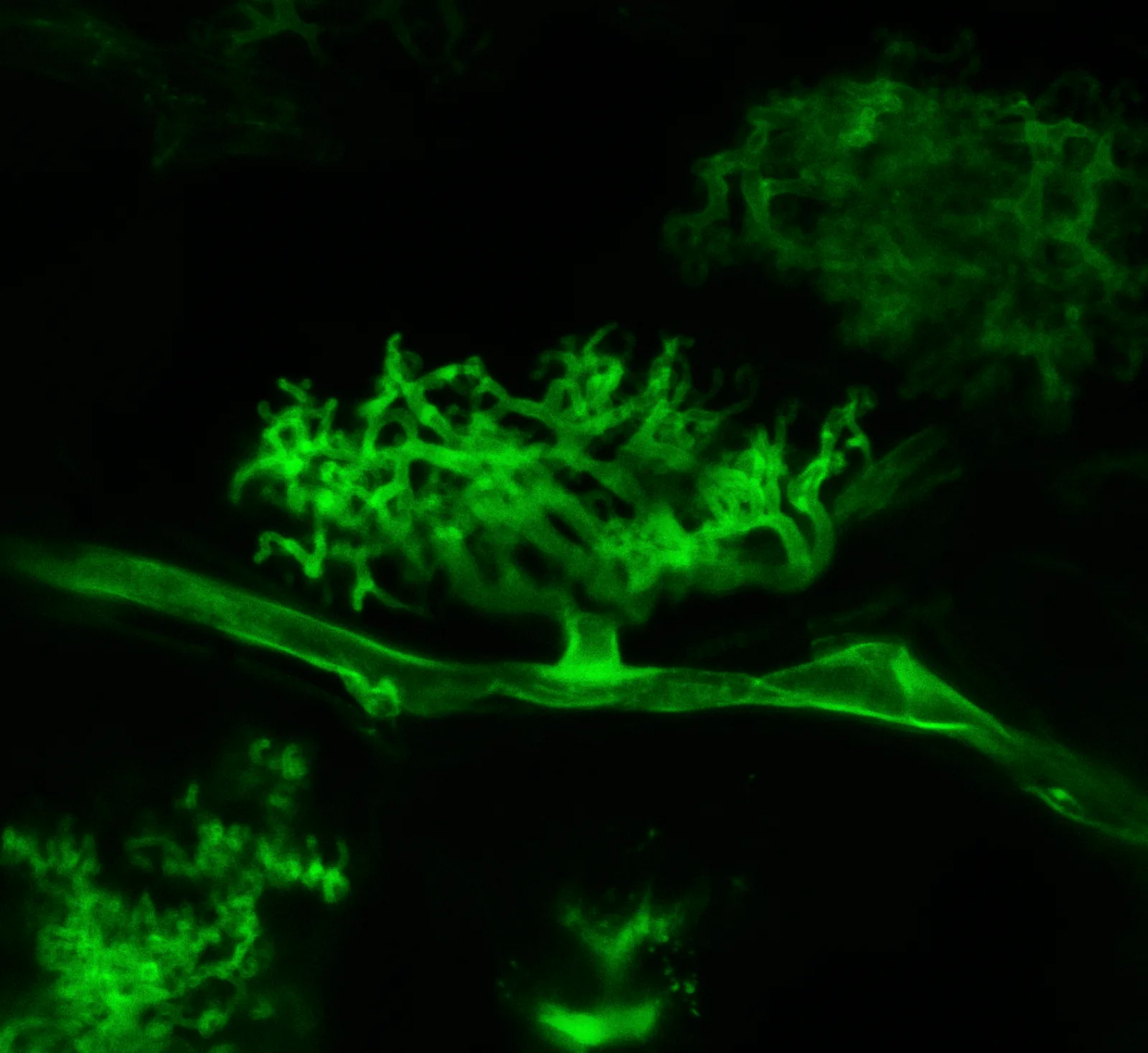
Documentary photograph: Arbuscular mycorrhizal fungi: resource exchange with roots