Explanation
Observing wildlife at dusk: distance, light and limits
Different species and behaviors may coincide at dusk: activity depends on the animal and local conditions. Watching from a distance and avoiding deliberate stimuli are precautions, not a guarantee that wildlife will not be disturbed.
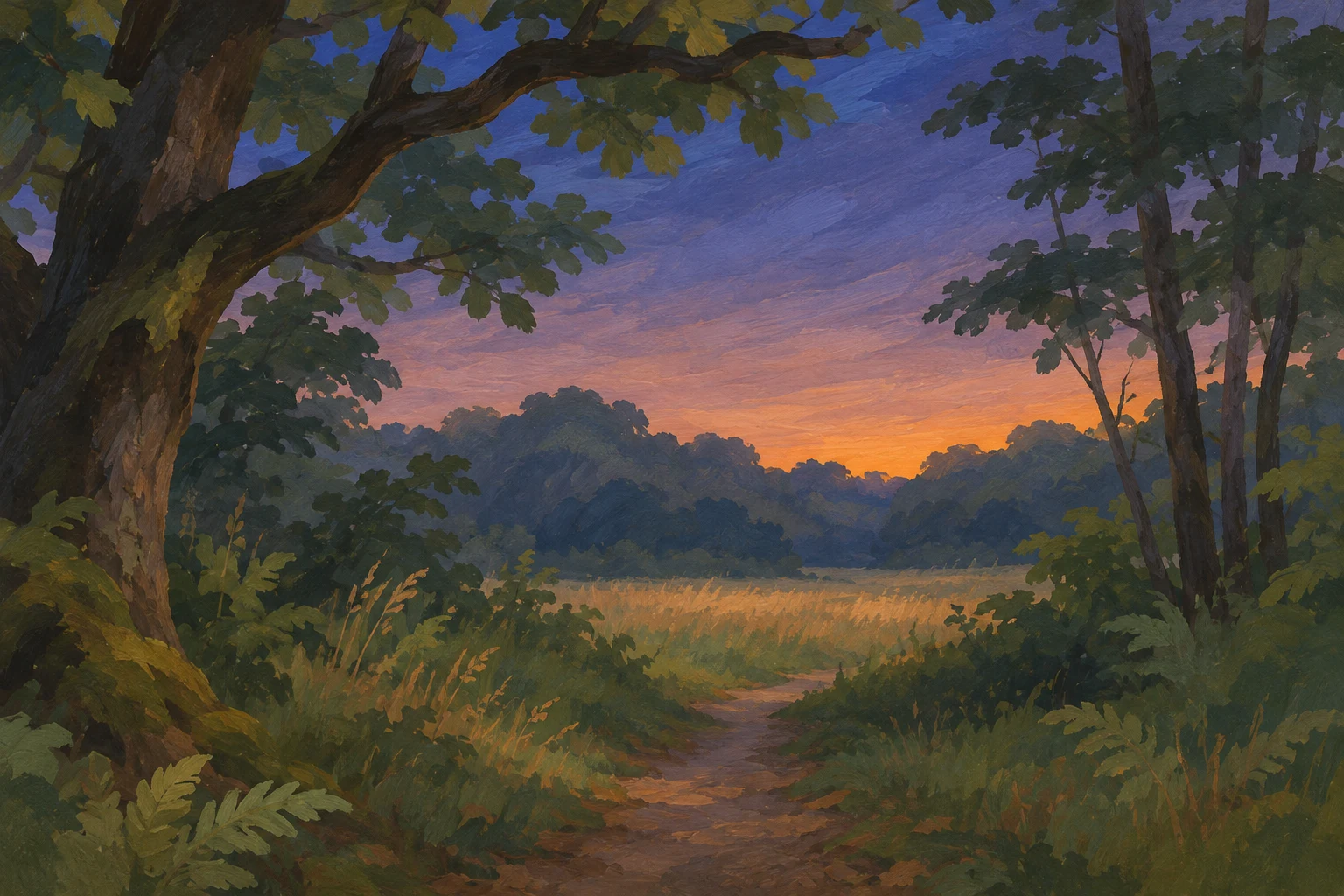
Dusk does not activate every animal
Dusk is a transition, not a signal that all wildlife is active. At Joshua Tree National Park, California, the U.S. National Park Service says that in summer, when temperatures can exceed 38 °C, desert animals are more active at night; it mentions snakes, bighorn sheep, kangaroo rats, coyotes and black-tailed jackrabbits. This is a localized, seasonal example, not a rule for other species or regions.
Observe without turning an encounter into an intervention
The U.S. National Park Service recommends observing wild animals from a safe distance in Badlands. Point Reyes cautions that wildlife sightings are not guaranteed and notes that taking time may help people observe. These are prudent recommendations, not evidence that a particular distance or duration eliminates all disturbance.
Artificial light can affect different species in different ways
In a semi-natural rural landscape in France’s Loire estuary, an acoustic study of 15 bat species identified two response groups: light-tolerant and light-intolerant species. The effect of lighting may also depend on the insects attracted to each type of light and on which of them bats prey on; therefore, a uniform response across a local community cannot be assumed.
An experimental result is not a rule for all wildlife
In a controlled study of 23 wild female Krefft’s gliders—a nocturnal marsupial from Australia—exposure to white and amber LEDs altered melatonin secretion; changes in glucocorticoid secretion were also observed, with responses differing by light type. The study detected no effects of the lighting treatment on the cellular immune response. These findings apply to one species and experimental conditions, not to all animals or every observation situation.
Nocturnal activity: observations and hypotheses
In Sabah, Malaysian Borneo, researchers used accelerometers to record the activity of six male proboscis monkeys. Nocturnal activity was lower than daytime activity, although it varied; among the five individuals included in the model, it was higher on cooler, rainier nights and after days with greater daytime activity. The authors could not determine whether nocturnal activity involved movement: location data were not collected at night. The findings describe the animals studied and cannot be generalized to the whole species.
A sensible precaution, not a promise of zero impact
To observe without deliberately intervening, keep your distance, do not use directed light or calls to make animals appear, and stop watching and move away if an individual changes its behavior. These are conservative precautions, not a proven method that guarantees no disturbance in every encounter. Research on lighting shows that responses vary among species and conditions.
Sources and references View references Hide references 5
- Animales - (U.S. National Park Service) www.nps.gov
- Badlands National Park www.nps.gov
- Short- and long-wavelength lights disrupt endocrine signalling ... pmc.ncbi.nlm.nih.gov
- The Influence of Low Intensities of Light Pollution on Bat ... pmc.ncbi.nlm.nih.gov