Explanation
How pollinating insects forage: signals, resources, and memory
Finding a flower, choosing a resource, and remembering a place are different actions. Studies of bees and butterflies help explain these differences without confusing a visit with effective pollination.
Foraging is not the same as pollinating
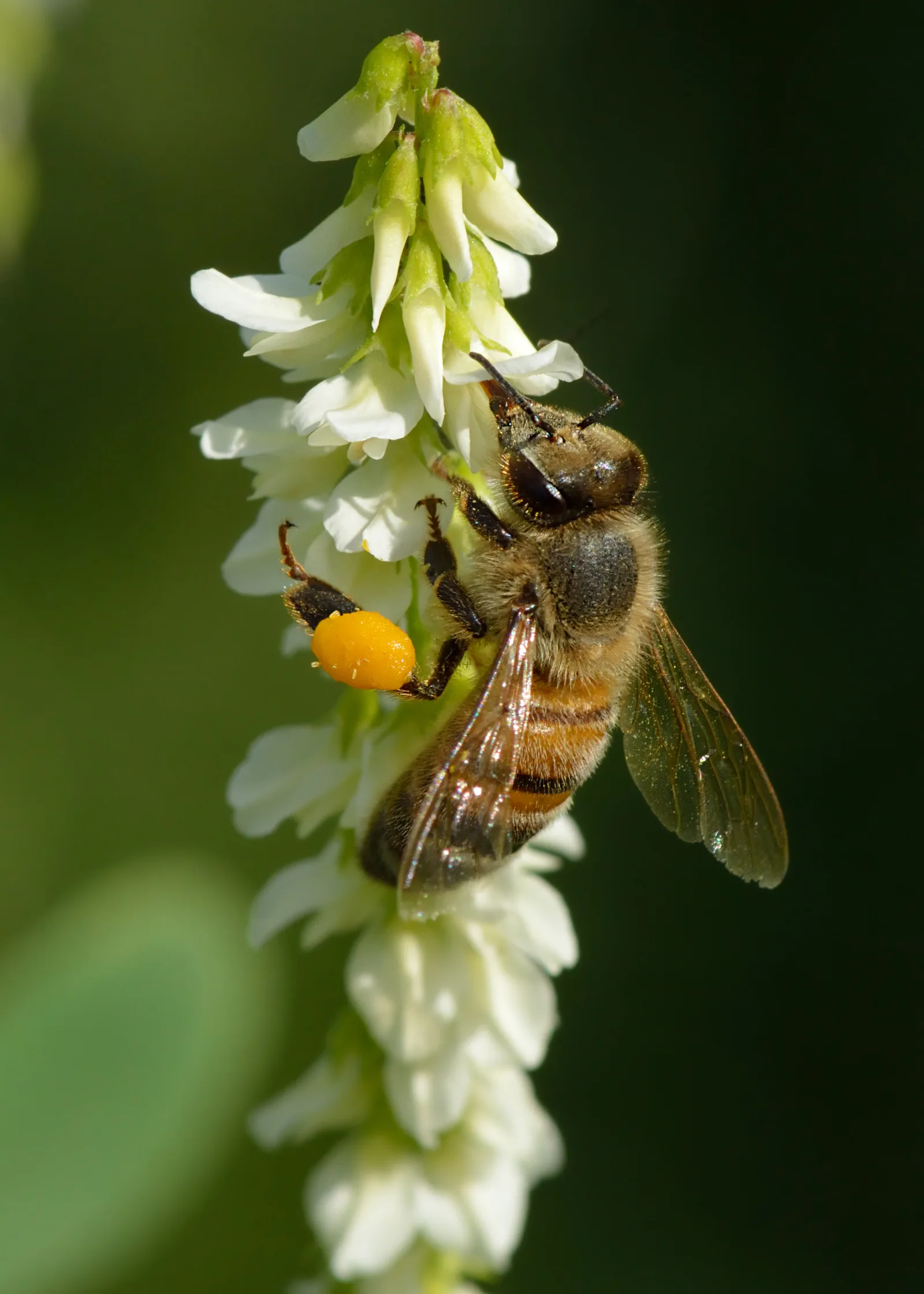
A floral visit may seem like a simple encounter, but it brings together several distinct actions: reaching a plant, choosing a flower, obtaining a resource, and moving on. Foraging and transporting pollen are related processes, but they are not equivalent. A bee may deliberately collect pollen; a butterfly may carry it while seeking another reward. Flowers also provide shelter or materials for building nests. Therefore, finding an insect resting on a flower does not, by itself, reveal what it is doing.
For bees, nectar and pollen serve different dietary functions. Nectar provides energy; pollen provides proteins and other nutrients, and much of it is used to feed larvae. Foraging should be understood in relation to these resources, without reducing every visit to drinking nectar. Nor should the same description be applied to all insects: the butterfly genus Heliconius, for example, includes pollen feeding, an important characteristic for studying its movements.
The function of the resource helps frame a specific question: is the visitor accessing nectar, handling pollen, or simply staying on the flower? If the behavior cannot be distinguished, the observation should preserve that uncertainty. Bees also transfer pollen from one plant to another. Assessing the reproductive effect of a particular visit is a further question; a sequence of visits does not automatically demonstrate that seeds have been produced.
Flower signals and access to the reward
Resources are not located solely by proximity. Flowers present visual and olfactory signals, along with shapes that determine how a visitor can gain access. Nectar is a sugary liquid produced by nectaries. Pollen contains, among other components, proteins, starch, and oils. These rewards should be distinguished from the signals that advertise their presence.
A useful distinction is between the color we see and ultraviolet reflectance. In some flowers, different areas of the petals or reproductive organs absorb ultraviolet radiation to varying degrees. Patterns called nectar guides can orient pollinating insects, although they are not visible to the human eye. The ultraviolet pattern should not be inferred from an ordinary photograph, nor should it be assumed that all flowers display it in the same way.
Scents also play a role. Some floral fragrances come from volatile compounds excreted by structures called osmophores. In certain flowers visited by flies, odors resemble decomposing organic material and can attract visitors seeking food or places to lay eggs. This specific relationship does not justify describing all flies as scavengers or treating every strong odor as an adaptation to the same group.
Shape completes the encounter: nectar at the bottom of a tubular corolla presents a different access challenge from a flower with a broad landing surface. Floral syndromes bring together sets of traits associated with particular visitors. They help interpret relationships, but a single signal does not identify with certainty which insect will visit a flower or demonstrate its effectiveness as a pollinator.
Choosing flowers: observable repetition and explanations
An insect may visit flowers of the same type in succession and then move on to another type. Observation lets us describe that sequence; explaining why it occurred requires more information. It is useful to separate three questions: which flowers were available, which ones the tracked individual visited, and what reward it found. The first concerns the surroundings, the second the observed behavior, and the third may require measurements that cannot be made by looking alone.
Floral constancy is studied as fidelity to a few flower species, or even just one, despite the availability of others offering a similar reward. The pattern alone does not demonstrate that the insect is maximizing energy or reducing a learning cost. Such explanations require comparisons with alternatives. For example, an apparently constant sequence may coincide with limited floral variety; without recording what was available, all of the repetition cannot be attributed to preference.
Studies of Heliconius raise a connection between repeated visits, information about the surroundings, and spatial memory. They offer a specific way to investigate foraging, but do not prove that all insects choose and remember flowers through the same mechanism. The difference between describing a pattern and demonstrating its cause is crucial: preserving it allows behavior to be explained without turning an appealing hypothesis into an established result.
A field study tracked the pollen diet of individuals from nine colonies of Bombus terrestris for up to six weeks. Only 23% of pollen-foraging trips were classified as constant. Individuals that were constant on one occasion could show different preferences on another. This result does not describe all bumblebees: it shows why fidelity recorded during one trip should not be turned into an invariable preference lasting for weeks.
How orientation was studied in butterflies
A study of Heliconiini butterflies compared representatives of Heliconius with relatives outside that genus. In response to a new floral resource, researchers characterized three patterns: circling flights, hovering, and feeding bouts. The groups studied showed these behaviors, but Heliconius spent more time performing them, especially hovering before landing.
The design was not limited to observing circles around a flower. Researchers investigated behaviors involving returns to the resource and changes in their expression with experience. They also recorded hovering in front of artificial feeders without floral signals or a food reward. This result indicates that floral odor was not essential to trigger the behavior under the tested conditions; it does not demonstrate that odors are unimportant in the natural environment.
The proposed interpretation is that these flights could provide opportunities to acquire sensory information and use it on subsequent visits. Resemblance to an orientation flight does not, by itself, prove a memory function. The behavioral mechanism by which butterflies acquire and use this information still needs investigation. Nor is it enough to see an insect flying in circles to claim that it is learning a route.
Brain anatomy provides context, using its own units of comparison. In Heliconius, mushroom bodies have been described as approximately four times larger relative to total brain size than in early-diverging genera within Heliconiini. These structures are associated with learning and memory. The anatomical comparison is not equivalent to demonstrating that a butterfly can store four times as many locations, and does not, by itself, identify the cause of each flight.
How many flowers there are and when they are available
Foraging takes place in a changing landscape. In a study of bees in southern Ontario, floral availability was estimated using flower counts and measurements. Open flowers were counted within sampling quadrats; for plants with many flowers per inflorescence, their number was estimated from a sample of individuals. In Asteraceae, flower heads were treated as floral units for counting. Knowing this decision is necessary to interpret what the compared quantities mean.
The researchers did not directly measure the entire reward of every flower encountered. They compared floral dimensions with data on daily nectar sugar mass for 46 species and pollen volume for 33, within a set of 96 recorded species. Floral volume was the indicator most strongly related to both resources and was used as a proxy in subsequent analyses. A proxy for a resource is not a direct measure of all the nectar or pollen available. Some measurements came from literature or herbarium images, another condition that should be retained when explaining the method.
In most of the landscapes studied, the lowest estimated resource abundance occurred at the end of summer. Peaks generally occurred in early or mid-summer, with a few late-spring exceptions. This is a result for the locations and periods sampled; it does not provide a universal calendar for other climates.
Responses also varied among groups. For Peponapis, resources were calculated using squash and cucumber flowers: during the study, visits by this genus were observed only on these plants, both members of Cucurbitaceae. For other genera, a broader set of rewarding plants was included. This decision shows why counting all flowers in a landscape is not equivalent to counting the resources relevant to a particular group. The authors also noted that short flight periods might be too brief to respond to fluctuations assessed on an approximately monthly scale.
A record that separates facts from inferences
For a descriptive observation, organize your notebook so that you can reconstruct what you saw. Record the location, date, and time, the plant observed, and the visitor’s identification to the level you can justify. Then record the sequence and recognizable actions. This is a way to organize observations, not a validated experimental protocol for estimating pollination effectiveness.
| Descriptive record | What it allows you to describe | What requires another check |
|---|---|---|
| A visitor lands on a flower | The presence and observed action | The resource consumed, if it was not visible |
| Successive visits by the same individual are followed | The sequence of flowers visited | The cause of repetition and its energetic benefit |
| Circling or hovering is observed | The form of movement | Whether its function is to memorize the location |
| Open flowers in a defined area are recorded | The floral availability counted according to that criterion | The actual amount of nectar and pollen in each flower |
If you lose sight of the insect, do not link the next visit to its route as if you knew it was the same individual. Keep observed actions separate from interpretations. Repeating the search in different seasons and at different times of day can reveal different visitors: this is an observation recommendation from the National Park Service, which also highlights the range of heights and plants where they can be found. An absence during a particular visit is not, by itself, a complete inventory.
The useful result is not a list of intentions attributed to insects. It is a description with context: what resource was being examined, what signals and access the flower presented, how the visitor moved, and what limitations the observation has. Experiments and landscape studies can advance from that description toward tested explanations, while always retaining the group, location, and conditions under which the results were obtained.
Sources and references View references Hide references 7
- Flor es.wikipedia.org
- About Pollinators U.S. National Park Service
- Seasonality of floral resources in relation to bee activity ... - PMC pmc.ncbi.nlm.nih.gov
- Heliconiini butterflies display flight behaviours reminiscent of ... pmc.ncbi.nlm.nih.gov