Explanation
How Horses See: Visual Field, Movement, and Changes in Posture
The position of a horse’s eyes gives it a wide but uneven visual field. What estimates of its field of vision mean, and how the head, light, and movement influence it.
A wide view that requires orienting the head
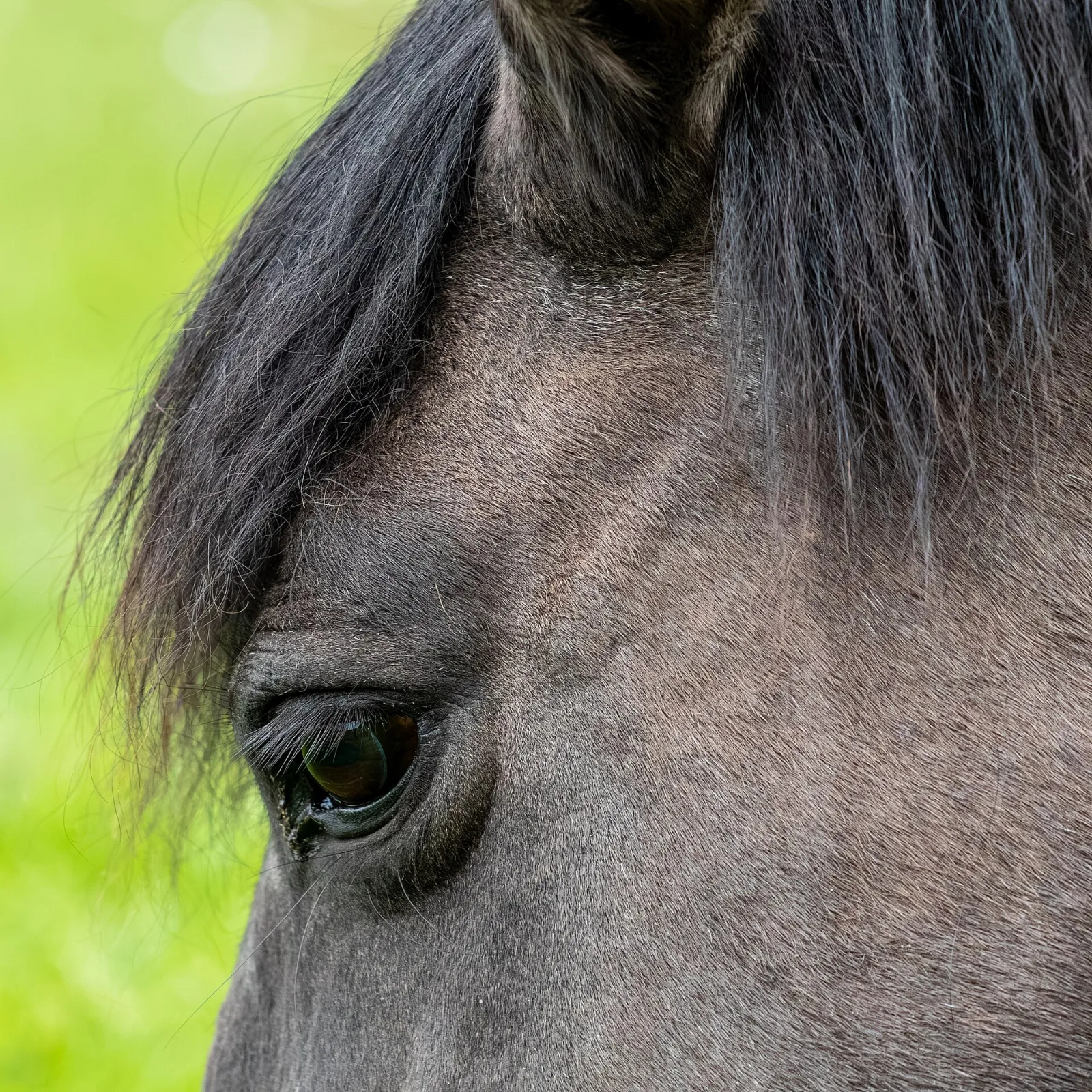
A horse’s eyes are positioned on the sides of its head and relatively high up. This arrangement favors panoramic vision around the animal, while the horizontally elliptical shape of the pupils is a characteristic of its visual system. Because the eyes move little within their sockets, looking toward something of interest involves turning the head. That is why observing how a horse positions its head helps show where it is looking; the position of the eyes alone is not enough.
A wide field does not mean that the whole environment is seen with the same level of detail or covered simultaneously. With the head still, there are small blind areas immediately in front of the nose and behind the tail. The front area should not be imagined as the entire scene in front of the horse: there is also a frontal binocular region. The blind areas near the head include sectors above and perpendicular to the forehead and directly below the nose; this fuller description locates the limitation in relation to the head rather than reducing it to two points on a plane. A small head movement can change which part of the surroundings is in view and compensate for these areas. The extent of the blind spots may vary somewhat according to eye placement, which is not identical in all types of horse.
Monocular and binocular zones: different functions
On each side of the head, the horse obtains visual information mainly from one eye: this is monocular vision. Farther forward, the fields of both eyes overlap to form the binocular zone, which extends in front of the muzzle and toward the ground. Thus, having laterally placed eyes does not mean having no binocular vision: the two modes occupy different regions of the visual field.
The overlap allows the brain to compare the slightly different images received by each retina. This binocular disparity provides information about depth. In experiments using visual illusions, horses showed sensitivity to binocular depth cues. This supports the conclusion that depth vision is not confined to animals with forward-facing eyes. However, it does not mean that the binocular zone is the only possible source of information about distance: familiar size and changes in an object’s appearance as it approaches can also provide cues, although less is known about how nonhuman mammals process some of them.
A widespread idea is that if a horse sees something with one eye, the other eye “hasn’t seen it.” Information from each eye reaches the brain and is not simply lost because it comes from one side. In a symbol-recognition task, horses trained with one eye covered were able to recognize the symbol when the other eye was covered. Available findings on the transfer of learning between eyes are mixed, so this example does not justify claiming that every object will always be recognized in the same way from the opposite side.
What visual-field figures express
Technical estimates provide a way to describe the extent of visual zones, not an exact map that guarantees detection of any object. IFCE gives the following estimates:
| Visual zone | Estimated angular values |
|---|---|
| Monocular, on each side | Average 195°; maximum 228° |
| Binocular | Between 55° and 65°; maximum 80° |
These figures are expressed as field angles, with ranges and maxima, and should not be confused with one another or interpreted as a measure of visual acuity.
The effective field also depends on head orientation and posture, as well as how the object is presented and the lighting. These figures therefore describe the general organization of vision, not what a particular individual will perceive in a specific situation. An object outside the direction of gaze may still fall within a wide field, but that does not make it possible to be sure the horse has identified it or what meaning it assigns to it.
Rods, cones, light, and movement
The retina contains photoreceptors with different functions. Rods contribute to visual sensitivity in low light and enable movement detection. Cones contribute to visual acuity—the perception of detail—and color perception. This distinction helps separate aspects of vision, but by itself it does not make it possible to deduce how a horse will react to a particular object: lighting conditions, the location of the stimulus, and the animal’s experience also play a part.
When moving from a bright environment to a dark one, photoreceptors begin adapting in about five minutes, and adaptation is considered complete after about 15–20 minutes. According to IFCE, these times are comparable to those observed in people; they do not support the idea that a horse’s eyes always need longer than human eyes to adapt physiologically to darkness. Even so, an abrupt transition to a very dark environment can cause reluctance or fear-related responses. The eye also has a tapetum lucidum, a structure that reflects light and provides the retina with a second stimulus, improving sensitivity in low-light conditions.
Movement can be especially striking, but it is useful to distinguish that observation from a complete measure of temporal vision. IFCE notes that horses can respond expressively to moving stimuli and that motion perception may be greater in peripheral regions. It also states that the temporal resolution of the equine eye—how many images per second it can perceive—had not been studied. Therefore, a visible response to a moving object does not allow a figure to be assigned to this ability or the reaction of any individual horse to be predicted with certainty.
Color and detail: the scene matters
The fact that cones are involved in color perception does not mean horses see colors in the same way as people. Environmental conditions matter too. In tests cited by IFCE, orange markings on cross-country obstacles were less visible to horses than white or blue ones. More errors and refusals were also observed with bars of a single light or dark color than with two-color bars, such as blue and white or red and white.
These results do not make any color a guarantee of visibility or performance. Lighting, weather, and ground color can change the obstacle’s contrast. The useful distinction is between a property of the object and what stands out in a particular scene: the same element can have different contrast depending on the background and light. Obstacle tests provide information about the conditions studied; they do not predict the behavior of all horses on every course.
Posture and surroundings can change what is in view
Panoramic vision is not independent of the position of the neck and head. According to IFCE, practices that hold these parts of the body in a fixed position can affect the visual field. In particular, postures in which the nose is behind the vertical can restrict it; the restriction increases as the posture becomes more extreme, with the nose closer to the chest or knees. A visual field described with the head in a different position should not be treated as if it stayed identical when posture changes.
Side shields—blinkers designed to limit the field of vision—deliberately reduce what a horse can see. In horses accustomed to wearing them, a greater increase in heart rate was observed in response to unexpected noises. This is a finding about a physiological response under those conditions, not proof that every individual reacts in the same way or a prediction of behavior in response to any stimulus. Taken together, these examples show why posture and equipment should be considered when interpreting what an animal may be seeing.
Observe without turning vision into a prediction
Eye position, head turns, and the direction of a stimulus provide complementary clues. When something appears to one side, it is worth remembering that it may lie in the monocular field; if the horse turns its head, it changes which zone it is looking at head-on and may bring both eyes to bear on the object. An object’s proximity to the body does not guarantee that it is within the visible field either: its position and the orientation of the head must be taken into account. These are ways to interpret visual geometry, not a way to know for certain what the horse has seen or how it will act.
To reduce avoidable surprises, it is reasonable to take abrupt transitions between light and darkness into account, allow the horse to orient its head, and not assume that a stimulus presented from one side will be perceived identically from the other. When assessing an obstacle, its contrast with the background also matters. These precautions follow from the observed limitations and conditions; they do not replace observation of the individual or guarantee a particular response.
Vision is only one part of a horse’s relationship with its surroundings. A review of equine vision frames the detection of possible threats in the context of an animal with a prey history and notes that head movements and attention to other group members may help direct where to look. This general explanation does not make it possible to label every reaction to a new or moving shape as fear, or to diagnose a visual problem. Differences in light, posture, learning, and living conditions may influence responses; understanding an individual case requires observing it in context, without inferring its state or ability from a single reaction.
Sources and references View references Hide references 3
- The horse's vision - équipédia - IFCE equipedia.ifce.fr
- Horse vision through two lenses: Tinbergen's Four Questions ... pmc.ncbi.nlm.nih.gov