Observation-guide
How to document a track without naming its maker too soon
Before assigning a name, record the print’s size and the arrangement of the trackway. A description can remain useful even when the species is unconfirmed.
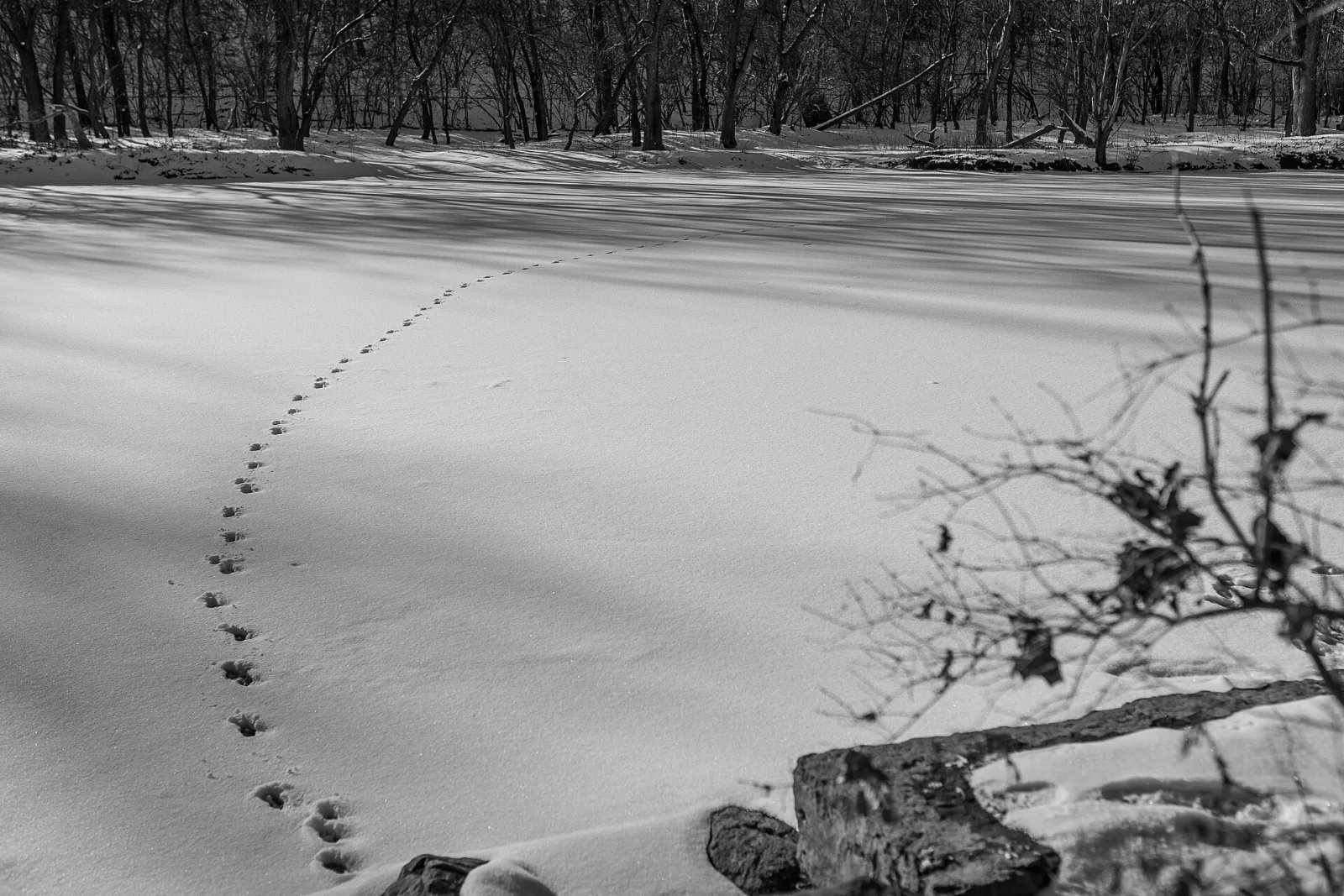
From resemblance to description
A mark resembling a familiar animal’s print can tempt you to name its maker immediately. An alternative is to start with what you can describe. The National Park Service’s educational activity Animal Track Detective combines two clues: track size and movement patterns. Its exercise uses simulated tracks and asks learners to justify answers through measurement and comparison. It is a starting point for learning to reason, not certification of every identification outdoors.
Measure the print and the trackway
As an adaptation for your notebook, keep one image of the print and another of the trackway, and record measurements you can take without losing the trail. Distinguish the size of one print from distances between prints: these are different data. In the exercise’s terminology, stride links successive prints of the same foot; trackway width is measured perpendicular to travel at its widest point. If you do not know which foot made each mark, do not label an arbitrary gap as stride.
A hypothesis open to revision
Then separate two entries: “What I observed” and “My interpretation”. Put measurements and arrangement in the first, and a possible identification with its supporting comparison in the second. This is a way to organise a notebook, not a rule for recognising every species. Retain unidentified when the information is insufficient. A cautious attribution can change with new observations; descriptions and images let you reconsider the track without relying solely on the name initially suggested.
Sources and references View references Hide references 1
- Animal Track Detective www.nps.gov