Observation-guide
How to Track Changes in an Urban Tree Without Disturbing Its Surroundings
A visual-recording guide, not an identification guide: observe from an accessible spot, note what changes, and keep description separate from explanation.
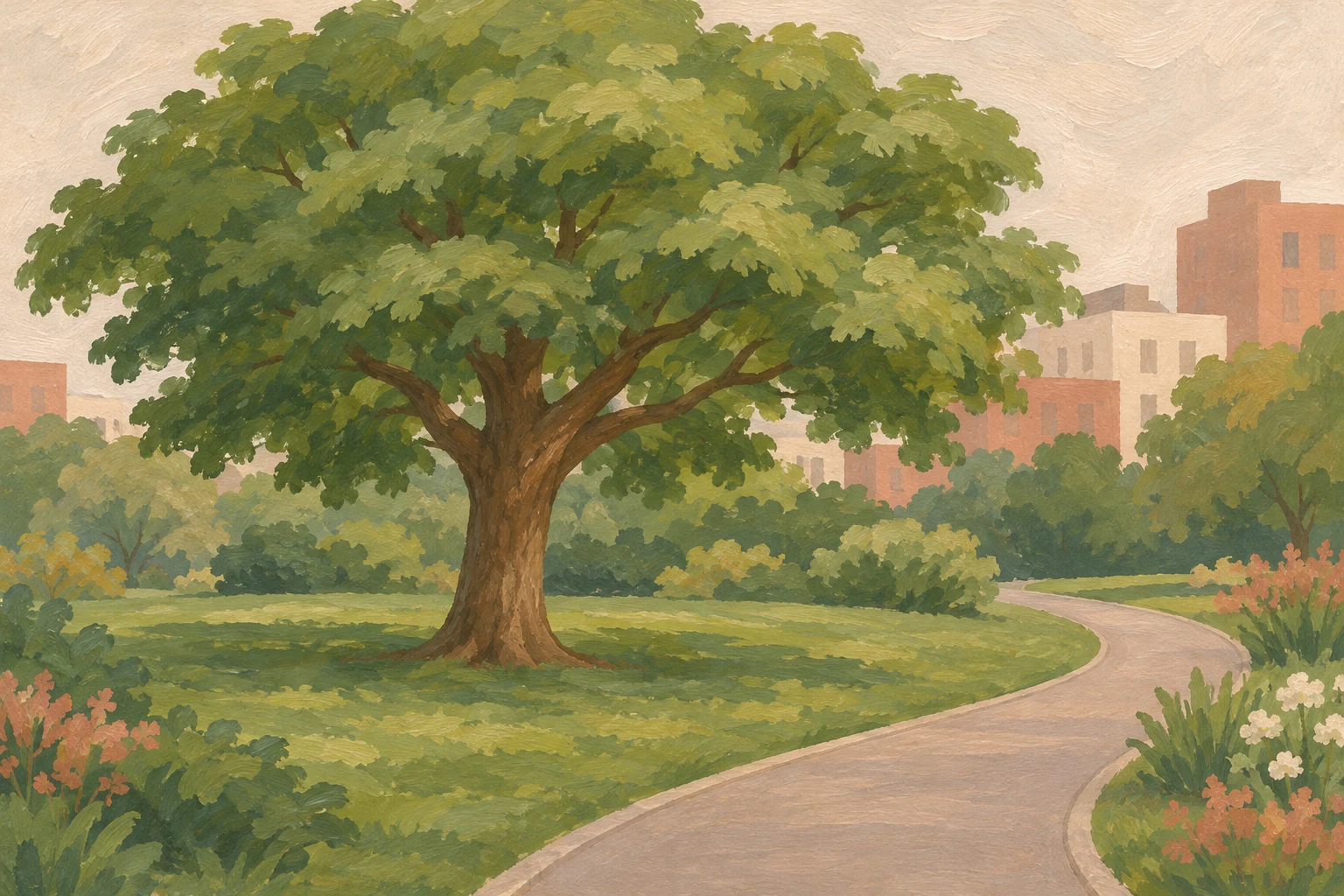
Observation, Not Diagnosis
Following a tree can be a way to pay attention to visible changes in it and its surroundings. Ecology studies relationships between organisms and the environment; that perspective invites you to see the tree as part of a place, without concluding from a single image what caused a change. This guide suggests a simple record, not species identification or a health assessment.
Before You Begin: Choose a Spot and Prepare Your Record
Choose a public or authorized place from which you can see the tree without leaving the path or approaching sensitive areas. Prepare a notebook or digital note and, if useful, a camera or phone. Choose a recognizable view that you can return to; do not mark the tree or leave objects beside it. These are practical suggestions offered here; they are not presented as a validated monitoring protocol.
What to Describe at a Glance
Note only what you can make out from your observation point: for example, whether the crown looks different, whether you can see leaves or flowers, or whether a branch has fallen to the ground. Describe the position and appearance in simple words, without touching leaves, bark, fruit, or branches to check an impression. If a detail is not clearly visible, record that limitation rather than filling in the observation with an assumption.
How to Keep a Comparable Record
On each visit, note the date, a general reference to the location, the point from which you observed, and a brief description. If you take a photo, try to repeat the framing without entering private spaces or restricted areas. Divide your note into two sections: “observed” for what is visible and “possible explanation” for ideas you have not yet confirmed. Repeating this routine is a suggested way to organize your records.
Avoiding Misinterpretation: Seeing a Change Does Not Explain Its Cause
A photograph may show a different appearance, but on its own it is not enough to establish why it changed. Avoid turning an impression—such as a crown that seems less dense—into a conclusion about the season, water, pruning, or the tree’s condition. Also record differences in framing or visibility that could make comparison difficult. Caution matters: the cited urban study measured air temperature, not changes in leaves, flowers, or branches.
Respect the Tree and Its Surroundings
Keep your observation non-invasive: do not handle plants or organisms, disturb the soil, or approach nests. Do not remove materials or leave anything at the site. Avoid publishing the precise location if it could expose a sensitive tree or organism; for personal tracking, a private reference that lets you recognize the spot is enough. If access is restricted, observe from outside or choose another place.
Scope of This Guide
A study of urban temperatures in eight U.S. cities measured air temperature with sensors during the summers of 2016 to 2019; it does not establish which visual features to use to track a tree or how to interpret its development. This guide therefore only suggests a visual-observation routine and does not attribute scientific findings to that protocol.
Sources and references View references Hide references 3
- Ecología es.wikipedia.org
- «Ecology» www.britannica.com
- Los árboles en las ciudades dan más que sombra www.usgs.gov