Explanation
In California wineries, fruit flies transport yeasts
A study at four wineries in the San Francisco Bay Area shows that fruit flies carry a variety of yeasts. The tests also reveal that attracting flies does not guarantee the same effect on their larvae.
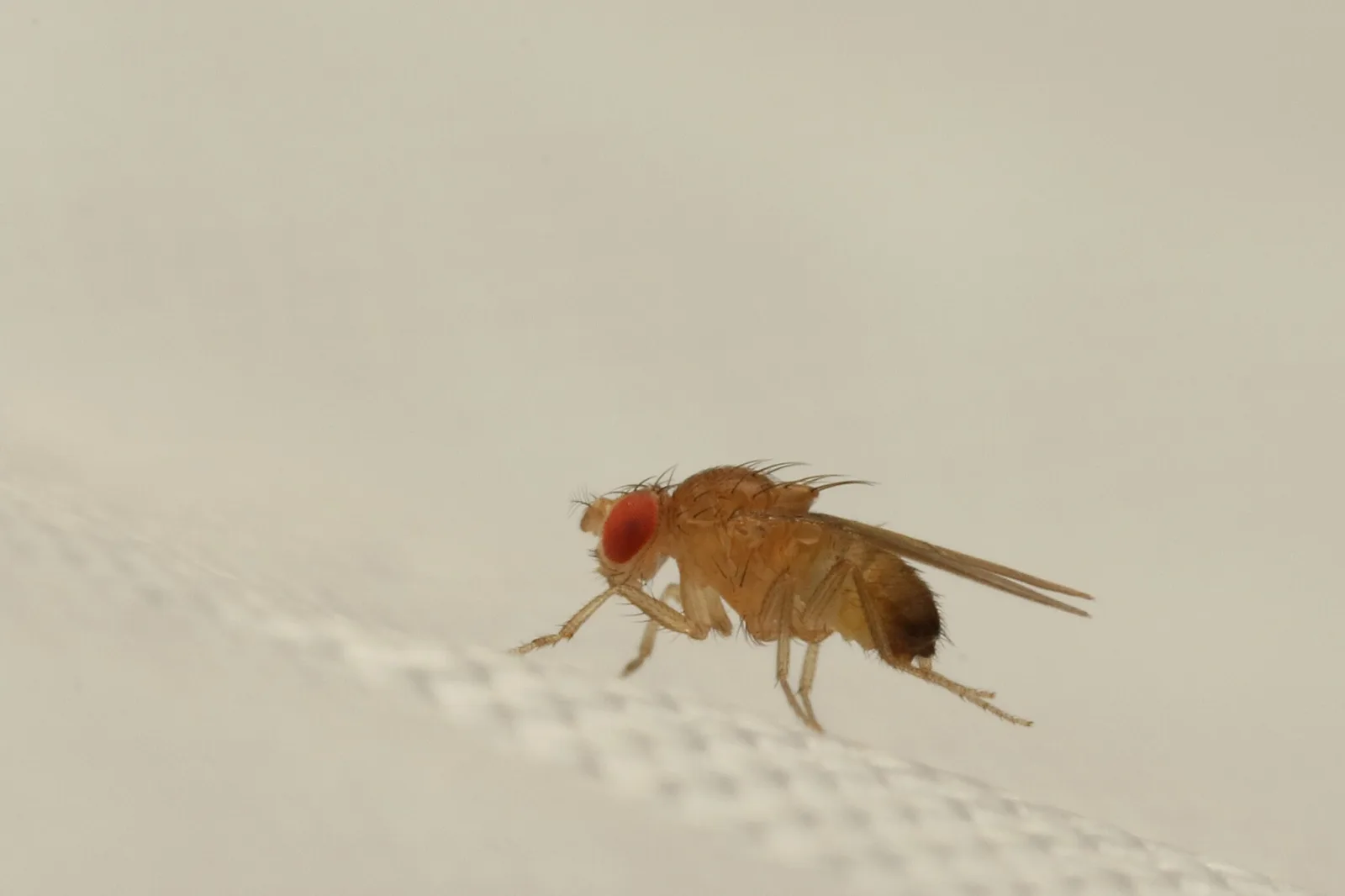
A study conducted at wineries
The evidence here concerns a specific context: four wineries in the San Francisco Bay Area, sampled during two harvest seasons. The team collected adult flies from fermentation tanks, winery buildings, and pomace piles, and analyzed the fungi associated with them. This is not an inventory of yeasts from all natural environments.
The flies carry a diverse set of yeasts
The study found that the sampled Drosophila carried a set of yeasts characteristic of wineries. In behavioral tests, the flies generally responded positively to yeasts they frequently carried. The finding documents an association in that environment; by itself, it does not establish that flies are the main means of yeast dispersal in vineyards or other ecosystems.
Attraction and benefit are not the same
The flies’ responses and the outcome for their larvae did not always match. In the tests, Pichia kluyveri was more attractive than other yeasts in both olfactory and egg-laying assays, but it was the only species studied that had a negative effect on larval fitness. Thus, a signal that attracts a fly does not by itself show that the food benefits the development of its offspring.
The intact grape surface is a different context
An independent study on Saccharomyces cerevisiae notes that this yeast is rarely found on intact grapes and that the grape-skin environment does not favor its stable residence. This helps distinguish the presence of yeasts in a winery or during fermentation from their persistence on intact fruit: these are different situations and should not be treated as a single community.
What these cases allow us to conclude
The findings describe interactions between flies and yeasts common in wineries, and do not define a single ecological role for wild yeasts. The authors leave open the question of whether the observed associations recur in places with fewer resources or on different fruits, such as apples; a review of Schizosaccharomyces also notes that little is known about the natural and artificial habitats of this genus.
Sources and references View references Hide references 3
- The ecology of the Drosophila-yeast mutualism in wineries. pmc.ncbi.nlm.nih.gov
- Adaptation of yeast Saccharomyces cerevisiae to grape-skin environment. pmc.ncbi.nlm.nih.gov