Natural-history
The red-legged partridge and changes in the agricultural landscape
The red-legged partridge depends on open and diverse environments. The sources document threats from intensification, abandonment, and hunting management, but do not quantify the relative weight of each factor in population trends.
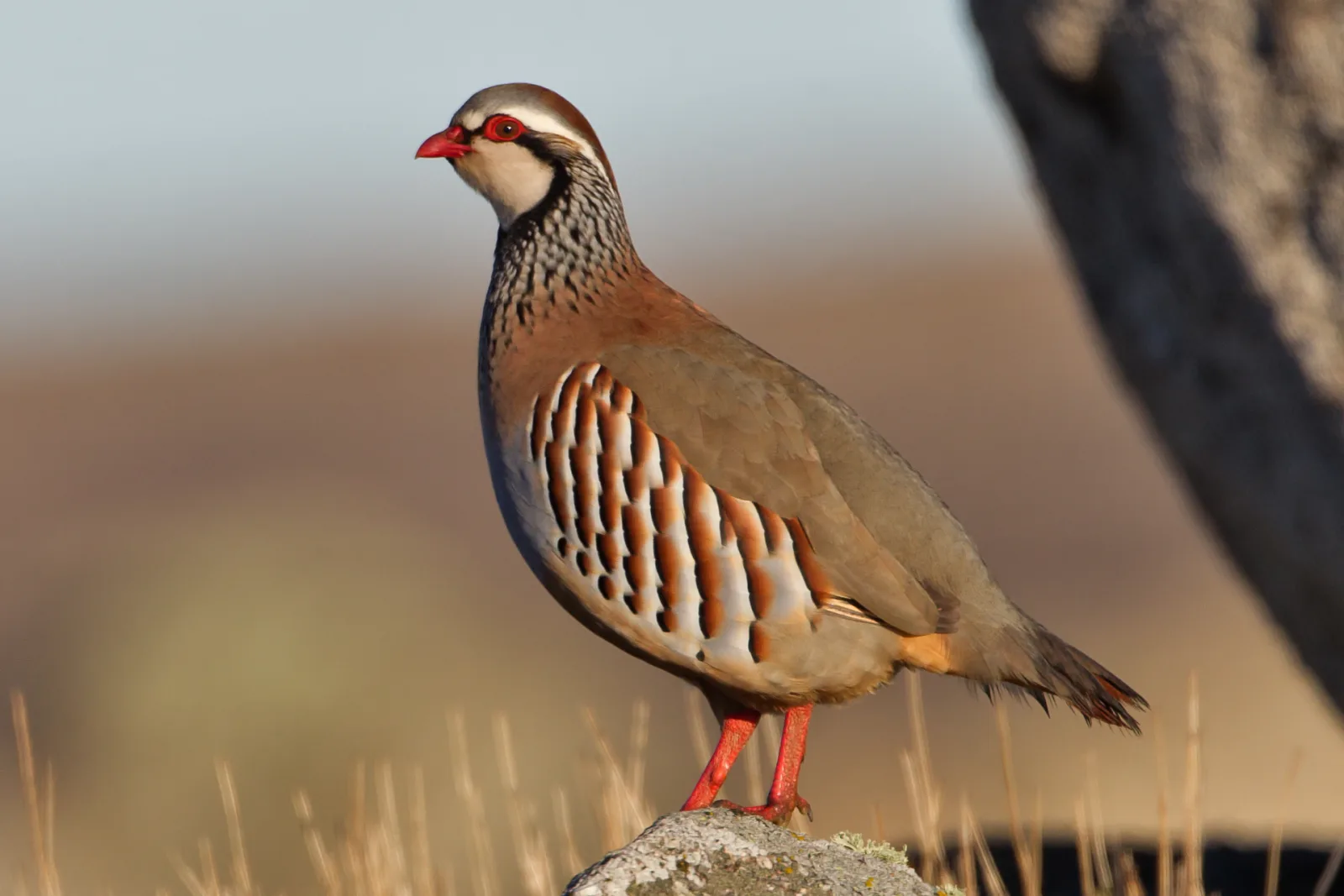
A species of open and varied environments
The red-legged partridge (Alectoris rufa) occupies a wide variety of open environments or areas with scattered trees: grasslands, crops, thinned scrubland, and dehesas. SEO/BirdLife indicates a preference for more diverse dryland agricultural plains. In terms of altitude, the species occurs from sea level to high mountain areas, although it is scarce above 1,500 meters, with records of presence up to 2,000 meters. These data describe habitats used and preferred; by themselves, they do not quantify the effect of a specific landscape on the population.
Different changes, related threats
The sources link habitat alteration to different processes: agricultural intensification, the abandonment of crops or grasslands—which may favor scrub encroachment—and changes in land use, such as conversion to irrigated agriculture or forest plantations. The MITECO fact sheet also mentions the loss of field boundaries, landscape homogenization, and the use of pesticides. Thus, this is not a single change or a uniform response: the sources identify several factors associated with habitat alteration, but do not provide a comparable estimate of their relative contribution.
Why the diversity of the mosaic matters
Among the proposed conservation measures, the sources include maintaining fallow land, field boundaries, and hedgerows, and promoting spatial heterogeneity through crop rotation. This places the diverse elements of the agricultural landscape at the center of recommendations for the species. However, the fact sheets consulted do not present experimental evidence that would allow a specific population effect to be attributed to each element separately.
Habitat and hunting management are not the same
SEO/BirdLife and MITECO also identify inadequate hunting management as a threat, referring to excessive hunting and restocking. This is distinct from agricultural changes and should not be confused with them. MITECO details that, in response to an increase in hunters, management criteria have been modified to reduce costs, promoting driven hunts and mass restocking while abandoning habitat management. Although some restocking may be justified, much of it is counterproductive because of the low acclimatization and survival rates of farm-bred partridges, genetic contamination by hybrids, and disease transmission. This pressure increases demand on wild populations. The available sources describe both types of pressure, but do not allow their relative weight in population trends to be separated precisely.
What can be concluded
The evidence consulted supports a clear relationship between the red-legged partridge and open environments, especially diverse agricultural plains, and documents threats linked to changes resulting from both intensification and abandonment. It does not establish how much each change contributes to the status of a particular population. The Sacre program reports a 40% decline since 1998, a national figure consistent with regional monitoring, but continuous, mass restocking could mask these trends. Nor is it appropriate to infer a current local trend from these general descriptions.
Sources and references View references Hide references 2
- Perdiz roja Alectoris rufa Ministerio para la Transición Ecológica y el Reto Demográfico
- Perdiz roja SEO/BirdLife