Observation-guide
Fallen feathers: how to observe them, name their parts, and know what not to identify
A feather’s shape, pattern, and anatomy offer clues for comparison with references. Learn to distinguish bird regions from feather types and understand why a single feather does not always reveal species, age, or sex.
First, describe what is in front of you
A fallen feather is a clue that can be described and compared, not a label identifying the bird it came from. Start by recording its general shape, approximate size, colors, bands or spots, and the condition of its edges. If you see it where it fell, a photograph that preserves that context may be more informative than an isolated image; even so, neither the location nor the pattern proves on its own which bird left it.
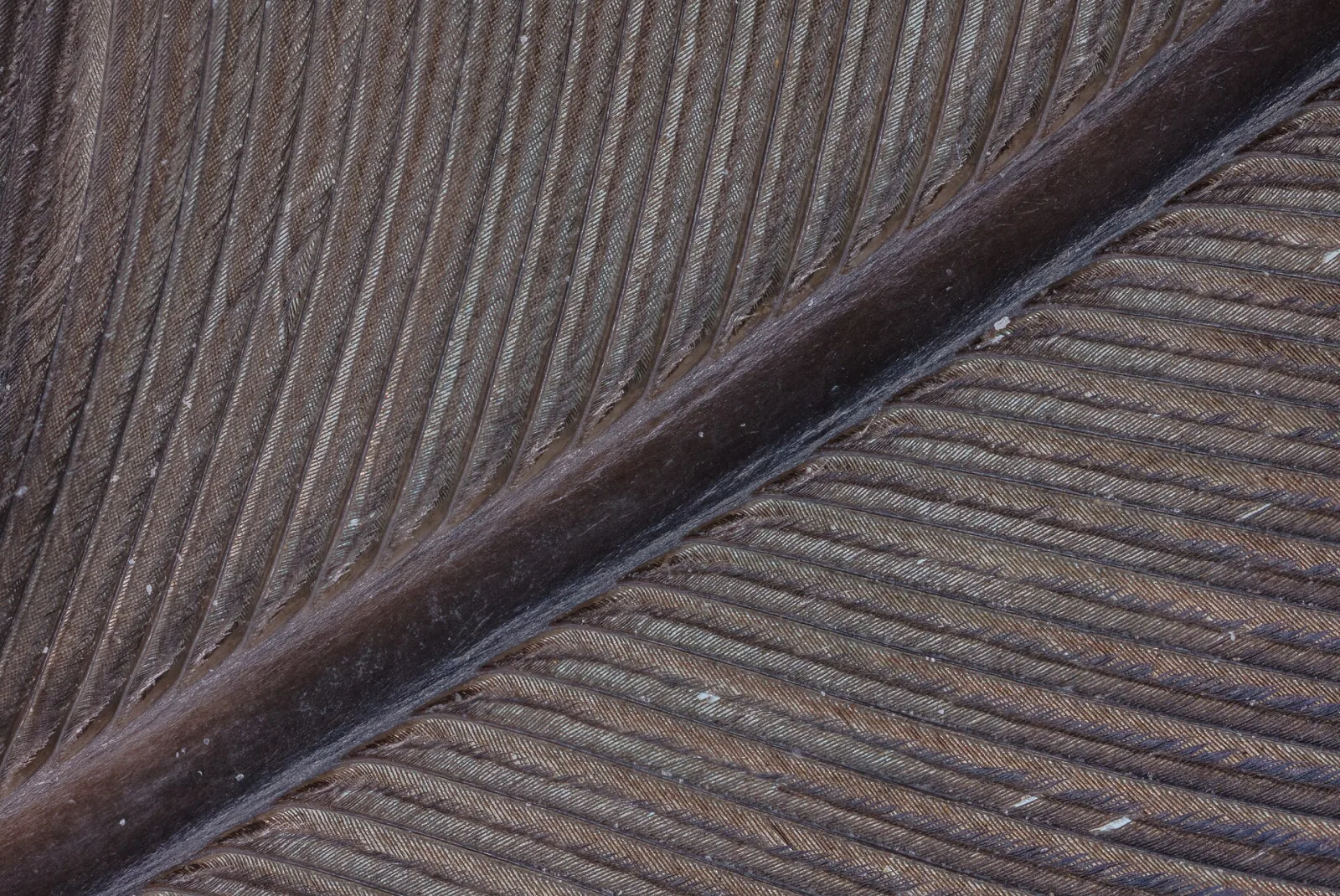
On a feather with a vane—the expanded surface on either side of the shaft—the rachis is the central shaft, and the barbs are the branches that extend from it. In many feathers, even smaller branches, the barbules, hook together and help hold the vane together. In down, by contrast, the branches tend to remain loose and form a fluffy structure. These differences help describe the feather and compare feathers of similar appearance; on their own, they do not establish its species or function.
It is useful to separate two questions that are often mixed together: which region of the bird would a feather come from? and what type of feather is it? “Wing” and “tail” name body regions; “primary,” “secondary,” “rectrix,” and “coverts” name categories of feathers associated with particular parts. A category provides a framework for comparison, but it does not mean that the exact location of every feather found on the ground is obvious.
Body regions and feather names
For orientation, the bird’s exterior can be divided into eight basic regions: bill, head, back, throat, breast, wings, tail, and legs. This is topographic vocabulary: it indicates where to look on the bird, not what kind of feather occurs there. The regions can be subdivided in greater detail—for example, by distinguishing areas of the head or markings on the wing—but this basic scheme is enough to avoid calling every elongated contour feather a “wing feather.”
Contour feathers form much of the body’s outer surface and overlap one another. Coverts are feathers that cover the bases of other wing feathers in the area where the flight feathers join the bone. The name does not refer to a separate region like the breast: it describes how they cover other feathers. A contour feather can cover the body without being a flight feather.
On the wing, remiges are the flight feathers. Among them, primaries occupy the outer half of the wing and secondaries the inner half. In flying birds, the primaries provide most of the forward thrust; the secondaries contribute most of the lift by overlapping to form an aerodynamic surface. Rectrices are the tail feathers and are important for steering in flight. Some birds have ornamental tail feathers that are not used for flight. Taken together, these categories explain why simply noticing that a feather is long or stiff is not enough to conclude that it belongs to the wing or tail.
| Name | Relationship to the body | What it describes |
|---|---|---|
| Primaries | Wing, outer half | Remiges on the outer part of the wing; contribute to thrust. |
| Secondaries | Wing, inner half | Remiges on the inner part; contribute to lift. |
| Rectrices | Tail | Tail feathers, important for steering in flight. |
| Coverts | Mainly wing, over the bases of other feathers | Feathers covering the area where flight feathers join the bone. |
| Down | Near the body | Soft, loose feathers that help with insulation. |
This table is a vocabulary guide, not a key for identifying a loose feather. The positions described refer to the bird with its feathers arranged on its body; when a detached feather is found, the information needed to assign it confidently to a particular region may be missing. Also, not all birds have wings that function in flight: wing feathers vary with each bird’s biology.
In the flying birds described here, the primaries attach to the part of the skeleton homologous to the human hand; the secondaries attach to the wing’s ulna. This anatomical relationship locates the feathers on the intact bird; it does not automatically identify a loose feather.
What patterns and visual references can tell you
Useful comparison begins with features that can be described without guessing: overall pattern, colors, bands, spots, vane shape, and the appearance of the barbs. Then, when possible, compare with references for the same type of feather. In a collection of feathers, the differences between a remex, a rectrix, a covert, and a body feather may matter more than a superficial similarity in color.
The U.S. Fish and Wildlife Service’s Feather Atlas brings together images of flight feathers from North American birds. It lets users explore images organized by groups and search for matches based on pattern, color, and other features. Its scope matters: it is a reference for flight feathers of North American birds, not a catalog of all feathers, species, or regions of the world. A match in some features offers a possibility to investigate, not automatic confirmation.
Anatomical illustrations help locate names, not determine the origin of a particular feather. The annotated photograph of body topography has original labels in Swedish; L. Shyamal’s wing diagram has labels in English—“Primaries,” “Secondaries,” and “Tertials.” The two illustrations included in this guide can be read alongside this glossary for orientation, bearing in mind the language of their labels and that the wing diagram does not turn an isolated feather into an identification. In every case, the aim is to learn where the categories occur on a bird, not to infer that every fallen feather retains enough clues to reconstruct its position.
Observing the whole bird also provides information that a detached feather no longer contains. Bird identification combines features of size and shape with markings on different regions, such as the head, back, throat, breast, wings, and tail. An isolated feather does not show that combination, the bird’s overall appearance, or its behavior. Visual references are therefore most useful for generating and comparing hypotheses, not for jumping straight to a species name.
A feather does not always reveal age or sex
Plumage patterns can vary with age, sex, season, and molt. Molt also does not always involve all feathers being replaced simultaneously: it can be complete or partial, and its timing varies among species and individuals. A bird can therefore have feathers with different degrees of wear or appearance during the same period, and a feather that is found does not necessarily represent the complete plumage it was carrying.
The Snowy Owl illustrates a specific limitation: descriptions of its plumage indicate that adult females and first-year males can overlap in appearance. This example does not establish a rule for other birds or mean that feathers never help estimate age or sex. It shows that even with information about the plumage, some groups can be difficult to distinguish; an isolated feather provides even less context.
There are cases in which feathers do allow more precise classifications within a controlled framework. In the U.S. Wing Survey program, for example, biologists examine wings from birds collected by participants in a hunting survey and can determine species, sex, and age from patterns, shape, color, wear, or replacement. This work relies on sample sets, protocols, and expertise, not on the assumption that any loose feather distinguishes these categories. The contrast helps define the limit: the fact that a clue is informative in a collection or specialist assessment does not guarantee that it is sufficient on its own in a casual observation.
When comparing options, preserve uncertainty if several birds fit the visible features. You can note “consistent with” or “possible,” record what you observed, and indicate what remains unresolved. Precision does not mean choosing a name at all costs; it means distinguishing what the feather shows from what the comparison has not yet demonstrated.
Molt, wear, and provenance: clues with limits
Feathers wear down and can be damaged; as keratinized structures, they do not repair themselves like living tissue. Birds replace them through molt, which can renew some or many feathers and change the appearance of the plumage. Visible wear is therefore a feature worth recording, not a reliable clock by itself: its meaning depends on the type of feather and the bird’s history.
Provenance can also be ambiguous. A feather found on a trail, beside a tree, or near water may have arrived there under different circumstances. Noting the location adds context, but does not prove that the bird that commonly uses that habitat left the feather. Likewise, several nearby feathers do not by themselves guarantee that they came from the same individual. Without direct observation or additional information, it is better to distinguish “where it was found” from “which bird left it.”
An orderly comparison can help without promising certainty:
Describe before identifying. Note shape, pattern, colors, bands or spots, and the condition of the barbs and edges.
Separate what is visible from what is inferred. Record what you see and the interpretation it suggests separately.
Compare equivalent feathers. If the category is unclear, do not assume that a reference for remiges applies to a body feather.
Check the scope of the reference. Review which species, regions, and feather types it includes; limit your conclusion to that scope.
Keep alternatives open. If more than one option fits, leave the identification tentative or undetermined.
This method does not replace expert identification or turn visual comparison into a diagnosis. It is a suggestion for organizing your own notes: it lets you record observed features and interpretations that remain uncertain; it is not presented as a validated protocol.
Observe and document without collecting it
You can photograph the feather where it lies and note its location and appearance, without capturing birds or handling wildlife. An image with a scale reference can help describe its size, provided it is obtained without touching the feather or disturbing the surroundings. Also record whether the surface appears worn, whether the vane is complete, and what pattern is visible. Avoid presenting the bird’s identity as fact if all you have found is a visual resemblance.
Possession of feathers may be regulated, and rules depend on the location and species. The Feather Atlas warns that, in the United States, possessing feathers from most native birds without the appropriate permits is illegal. This warning does not automatically describe regulations in other countries or replace checking local rules. If in doubt, observing and photographing without collecting the feather avoids turning a natural curiosity into a question of possession.
A fallen feather can reveal details of shape, structure, and pattern; it can also suggest which category it belongs to and allow informed comparisons with relevant references. What it does not always provide is its exact location on the body, the species’ identity, or the age and sex of the bird it came from. The clues are real; certainty depends on how much context the observation retains and how comparable the reference is.
How to read the included illustrations
This guide includes two distinct illustrations that accompany the glossary: the annotated profile photograph of a bird shows body regions with original labels in Swedish; L. Shyamal’s wing diagram shows groups of feathers and bones with original labels in English. In the latter, Primaries correspond to primaries, Secondaries to secondaries, and Tertials to tertials. The captions for both images identify the authorship, source, and license of each resource.
Use the body photograph to relate the regions described in the text to a whole bird, and the wing diagram to distinguish the outer and inner halves where primaries and secondaries are located. They are aids to anatomical vocabulary, not keys that confirm the species or provenance of a fallen feather. The labels are retained in their original languages; the explanations in this glossary provide orientation without claiming that the images themselves have been translated.
To explore anatomical vocabulary further, you can consult All About Bird Anatomy by Bird Academy, linked by Cornell in its anatomy resources. This external resource is distinct from the illustrations included here; its images are not copied, and the availability of every feature or language is not guaranteed.
Sources and references View references Hide references 8
- Bird Cams FAQ: Snowy Owl Nest www.allaboutbirds.org
- Everything You Need To Know About Feathers academy.allaboutbirds.org
- Bird ID Skills: Field Marks www.allaboutbirds.org
- Migratory Bird Parts Collection Survey www.fws.gov
- The Basics: Feather Molt www.allaboutbirds.org
- Moult in Birds — BTO ornithological reference, flight-feather positions British Trust for Ornithology
- Cornell Lab anatomy-workshop FAQ — official All About Bird Anatomy resource link Cornell Lab of Ornithology
See and listen
Images, sounds and scenes
Resources that complement the information, with their origins and reuse conditions.
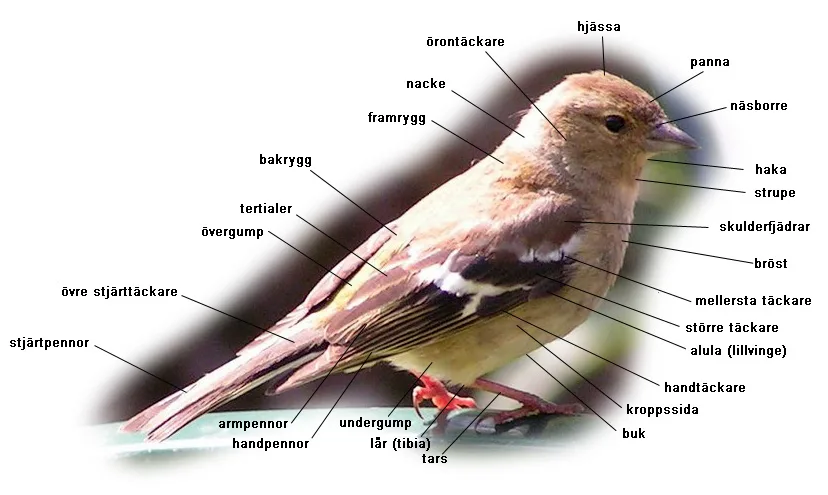
Photograph by sannse, annotations by AHA, CC BY-SA 3.0. Original Swedish labels retained; the text glossary explains the main regions. Re-encoded presentation copy; it does not establish the origin of a fallen feather.
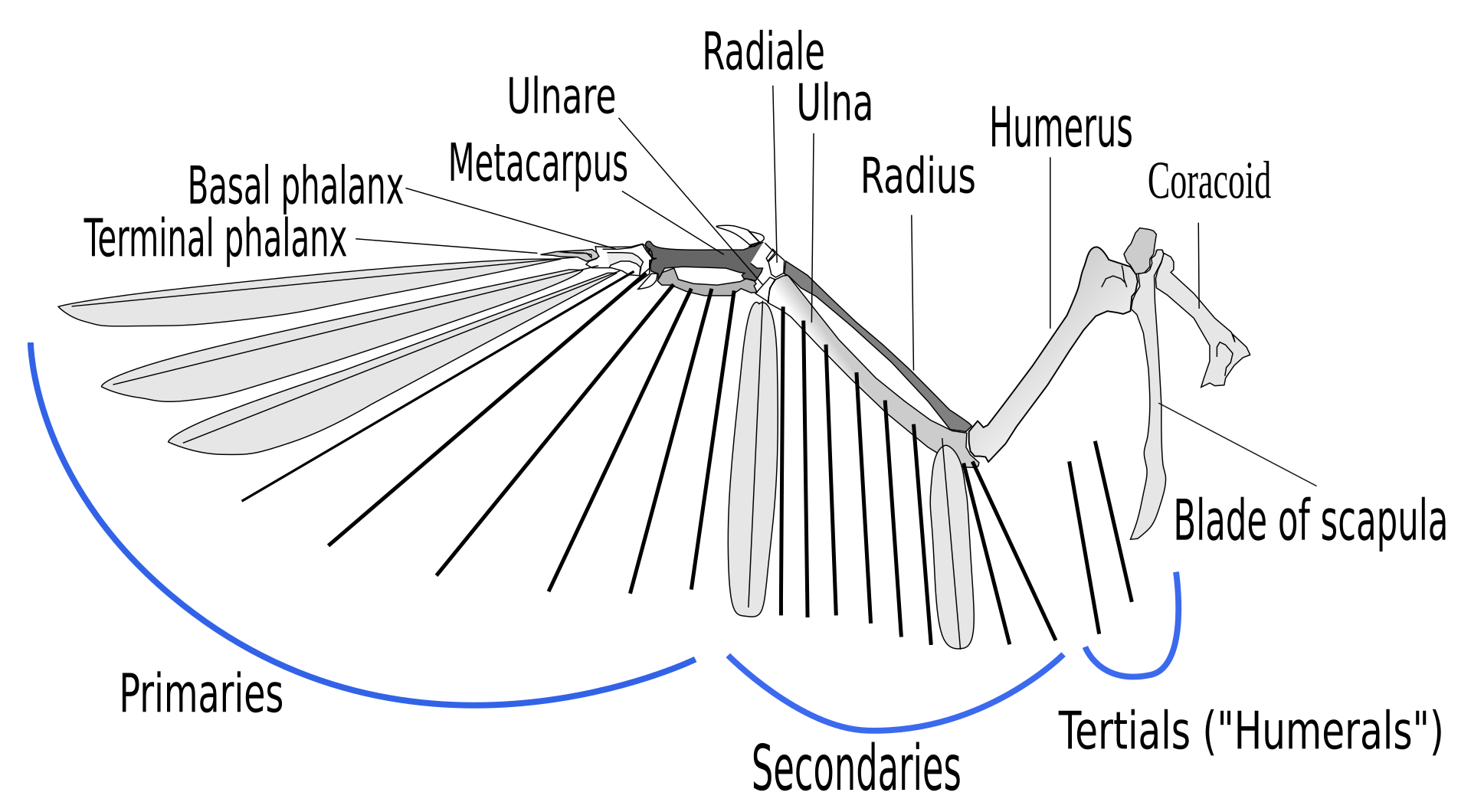
L. Shyamal, Birdwing.svg, CC BY-SA 2.5. Commons presentation PNG; original English labels retained. Anatomical diagram, not a species identification key.